
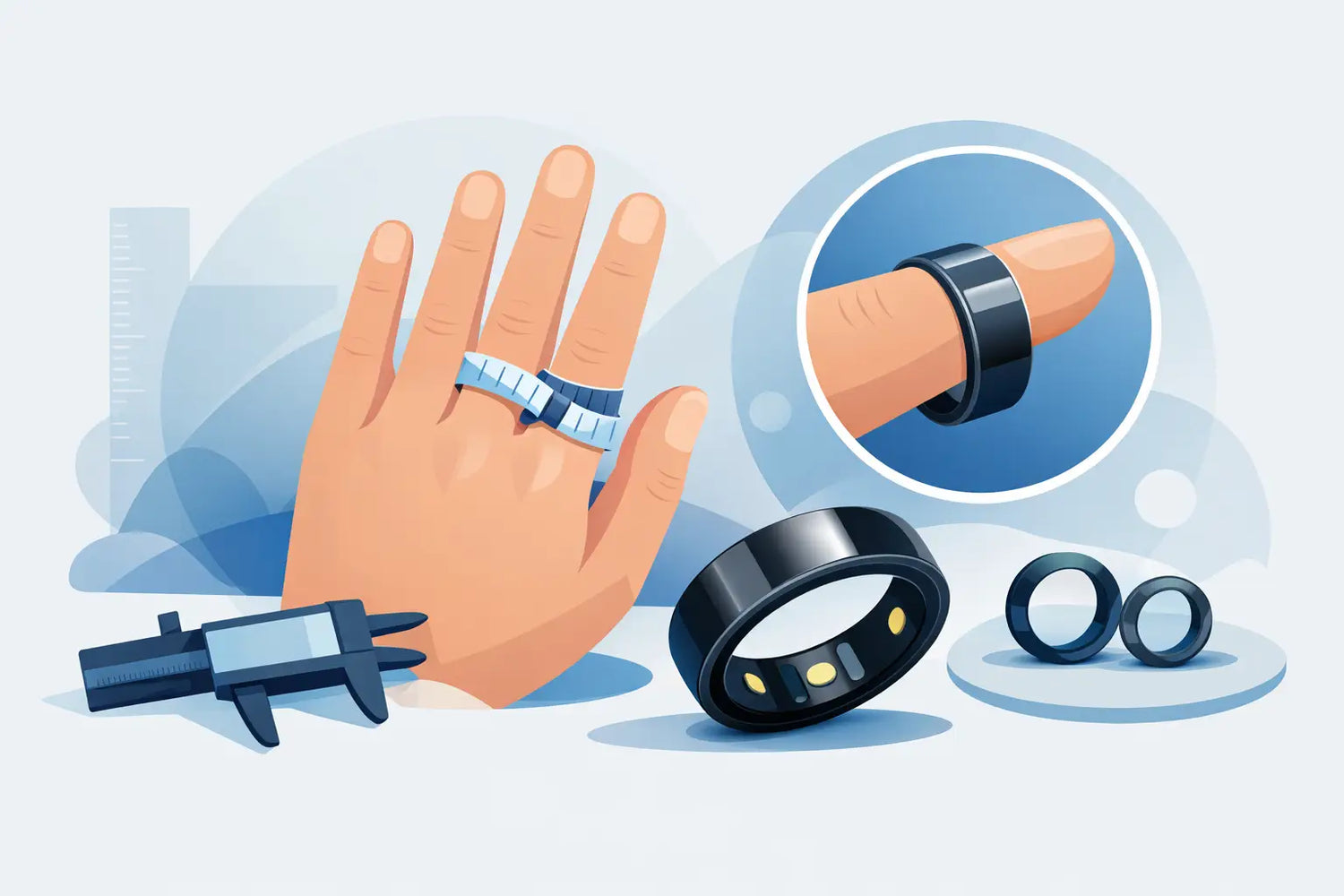
A smart ring can be as advanced as it wants in design and technology - but if the size doesn't fit, you'll notice it every day. If it's too tight, it'll be uncomfortable in everyday life; if it's too loose, it may provide less accurate measurements and will never feel quite right. That's exactly why measuring your smart ring size shouldn't be an afterthought, but something you do properly and stress-free.
The good news: you don't need a jewelry store or complicated tools for this. With the right method, you can determine your ring size at home quite accurately. What matters less is whether you measure, but how you measure.
Why measuring your smart ring size correctly makes such a big difference
A traditional ring can fit a little looser if it's worn primarily as jewelry. Different rules apply to a smart ring. The sensors must reliably rest against the skin to accurately capture sleep, heart rate, activity, and other metrics.
If the ring is too loose, it can spin on your finger or slip out of place when you move. This changes the contact with your skin, which can affect measurement quality. If it's too tight, it will quickly become uncomfortable - especially in the evening, in warm weather, after exercise, or at the end of a long day at work.
The right size is therefore not a minor detail, but the foundation for comfort and data quality. Investing a few minutes here can save you uncertainty, exchanges, and daily readjustments later.
Which finger is best for a smart ring?
Before you measure, you should first decide which finger you actually want to wear the ring on. This is often underestimated. Many people spontaneously try the ring finger, but later switch to their index or middle finger because the smart ring feels more secure there.
It's important to remember that every finger has a different circumference. Your dominant hand may also be slightly larger than the other. So if you measure your left ring finger but want to wear the ring on your right index finger later, the result won't be very useful.
For many users, the index, middle, or ring finger works best. What feels most comfortable depends on your daily routine. Those who type, exercise, or work with their hands a lot often notice differences immediately. Therefore, choose the finger that will feel realistically comfortable in the long term - not just for five minutes while testing.
Measuring your smart ring size - the most reliable methods
The safest option is always a digital ring-measuring tool or a physical measuring kit designed for smart rings. These solutions are usually more accurate than improvised methods because they better reflect the actual shape of the ring. This level of accuracy is especially worthwhile for a wearable that needs to fit and measure continuously.
If you want to measure at home, there are still good ways to do it. The important thing is to work carefully and not just accept the first result you get.
Method 1: Measuring with an existing ring
If you already own a ring that fits exactly on the finger you want to wear the smart ring on, you have a good starting point. Then measure the inner diameter of this ring as precisely as possible with a ruler or, even better, a caliper.
The catch: Many existing rings may fit approximately, but not ideally for a smart ring. Jewelry can fit a little looser, while a smart ring should fit more securely. Therefore, only use this method if the comparison ring really fits comfortably, securely, and well in everyday life.
Method 2: Determining finger circumference with paper or string
The best-known method at home is a narrow strip of paper or a non-stretch string. Wrap it around the finger where the ring will later sit. Mark the point where the ends meet, and then measure the length in millimeters.
This method works, but it has weaknesses. Paper can slip, string is easily pulled too tight, and the result can quickly be inaccurate. If you measure this way, repeat the process several times and never pull it tight. The strip should fit snugly but still feel comfortable.
Method 3: Using a digital ring-measuring tool
A digital ring-measuring tool is the easiest solution for many, because it makes the purchasing process simpler and more secure. Especially if you are ordering a smart ring online and want clarity right away. The advantage lies in the user guidance: you get clear direction without having to interpret charts yourself.
This is often the most practical option for people buying a smart ring for the first time. If you also benefit from free exchanges, it takes even more pressure off the decision.
The most common measuring mistakes
Most incorrect sizes are not caused by people not measuring at all, but by measuring under the wrong conditions. Fingers change their circumference throughout the day. They can be narrower in the morning and slightly fuller in the evening. Differences are also normal after exercise, in hot weather, or after eating salty food.
Therefore, do not measure immediately after a workout or with ice-cold hands. The ideal time is a normal time of day when your body is in its usual state. It is even better to measure two or three times at different times and compare the results.
Another typical mistake: choosing too small because you are afraid of a loose fit. This may sound logical at first, but it often catches up with you after a few hours. A smart ring should fit securely, but not press. If it is only comfortable in the morning and bothers you in the evening, it is too tight.
Finger joints are also often forgotten. Some fingers are narrower at the base but have a more pronounced joint. In that case, the ring must fit over the joint, but still sit securely at the bottom of the finger. This is exactly where you can see why pure millimeter measurements are sometimes only half the story.
How a smart ring should fit properly
A well-fitting smart ring feels secure without being restrictive. It should be able to move over the joint with slight resistance and not slide back and forth on the finger. When you move your hand normally, it should not immediately tilt or rotate significantly.
Slight rotation in everyday life is not automatically a problem. It becomes critical if the ring constantly shifts or feels loose even with small movements. Then the skin contact is not consistent enough. Conversely: if you immediately notice pressure points or feel like you want to take the ring off right away, the size is too small.
Many users prefer the fit to be such that the ring is consciously noticeable but not bothersome. That is a good benchmark. A smart ring is not a piece of jewelry that you completely forget - it is a precise wearable that needs to work close to the skin.
What to do if you are between two sizes?
This is one of the most common cases - and there is no one-size-fits-all answer. It depends on which finger you wear the ring on, how much your fingers swell throughout the day, and how tight you generally like your wearables.
If your finger size fluctuates significantly, the slightly larger version is often more suitable for everyday life. If you are between two sizes but have a rather narrow, consistent finger and prioritize a secure fit, the smaller one may be better. The important thing is whether the ring still feels comfortable after several hours.
That is exactly why flexible services are so valuable. Those who know that a free exchange is possible can make the decision with much more confidence. This greatly lowers the barrier to buying online.
This is why a secure purchasing process is worth it
With smart wearables, not only the product matters, but also how you feel before buying. No one wants to guess whether the ring will fit and then be stuck with the risk. A good provider takes this uncertainty seriously - with clear size guides, a simple measuring process, and a fair solution if the first choice is not perfect after all.
That is exactly what makes the difference between a complicated purchase and a relaxed decision. When size guidance, exchange options, and a testing phase are properly considered, uncertainty turns into confidence. For brands like Fitorb, this is not a minor detail, but part of the product experience.
When you should measure again
If your measurements fluctuate significantly depending on the time of day, if you end up between two sizes, or if the desired finger has a pronounced joint, a second check is almost always worthwhile. The same applies if you have never worn a ring regularly before. Then you often lack the feeling for what is permanently comfortable.
Even when unsure between style and function, measuring again helps. Some people prefer to wear the ring discreetly, while others want it particularly tight for a secure feeling. Both are understandable. In the end, it is not about which size seems logical on paper, but which one fits reliably in everyday life.
A smart ring accompanies you while sleeping, in the office, on the go, and during exercise. That is exactly why the size should not be guessed, but consciously chosen. Those who take measuring your smart ring size seriously take the most important step before buying - and ensure that technology, comfort, and everyday life fit together from the start.



Leave a comment
This site is protected by hCaptcha and the hCaptcha Privacy Policy and Terms of Service apply.