
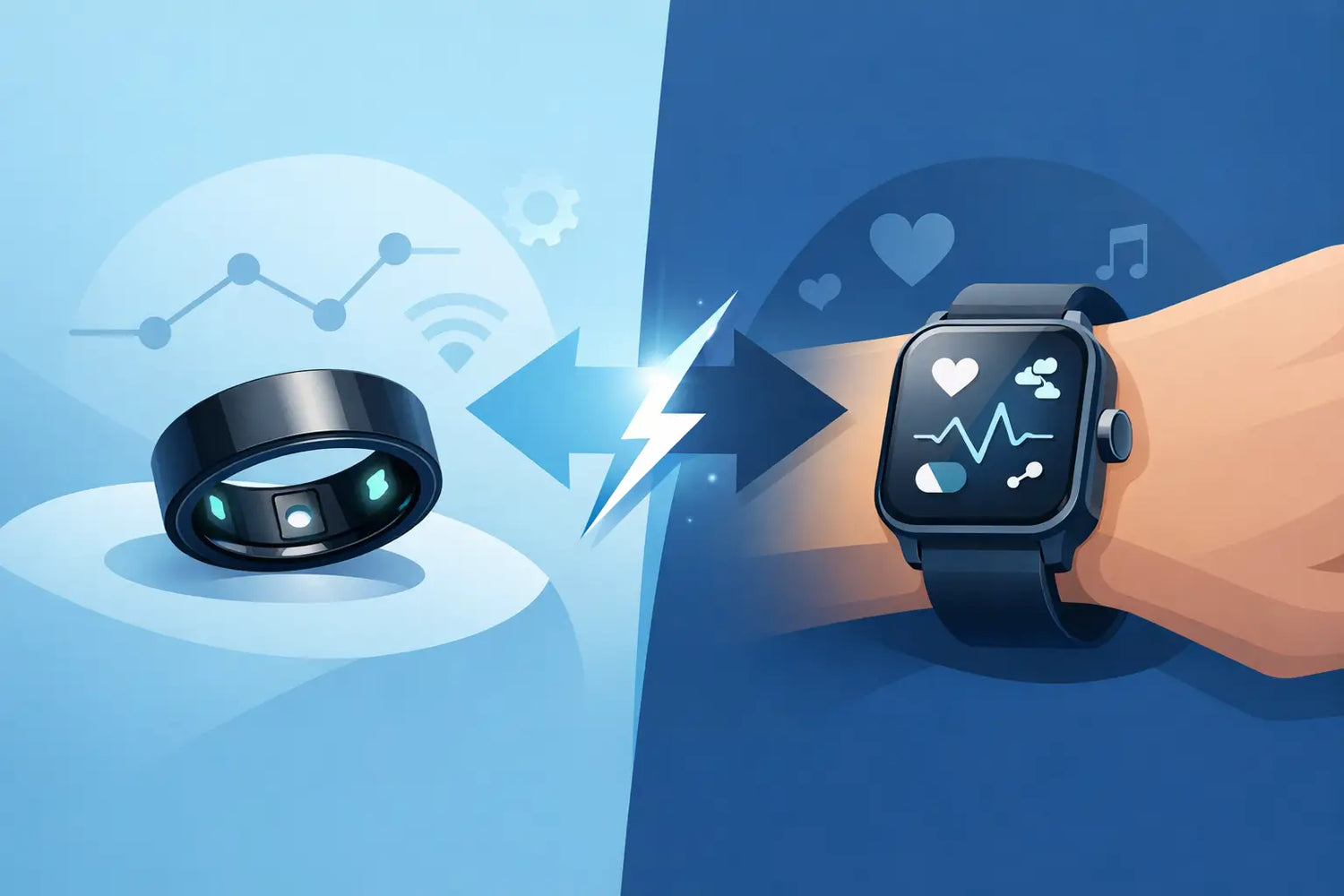
Whoever checks their sleep score first in the morning, wants to keep an eye on their steps during the day, but still doesn't want to wear conspicuous technology on their wrist in the evening, will quickly come to the same question: smart ring or smartwatch difference - which really suits everyday life better? Exactly here, it is not only the technology that matters, but above all how inconspicuous, comfortable, and consistent a wearable fits into your life.
Smart ring or smartwatch - what is the real difference?
On paper, both devices can do similar things: record activity, analyze sleep, collect health data, and evaluate it via an app. But in everyday life, the difference feels much greater than many initially think.
A smartwatch sits visibly on the wrist. It is usually larger, more interactive, and closer to a small smartphone. A smart ring, on the other hand, focuses on what many really use regularly: health and activity data, worn discreetly, lightweight, and without the feeling of constantly carrying a display with you.
This is the core of the decision. Anyone who wants notifications, apps, phone functions, and a display directly on their arm will likely lean towards the smartwatch. Anyone who primarily wants to track health, sleep, and daily activity without changing their own style will often find the smart ring to be the much more pleasant solution.
The biggest difference in everyday life: visible or inconspicuous
Many purchasing decisions fail not because of functions, but because of habits. A smartwatch can be technically powerful - but if it bothers you at night, looks too sporty in the office, or simply doesn't fit the outfit, it will quickly be worn less often. And a wearable only provides useful data if it actually stays on your body regularly.
This is exactly where a smart ring plays to its strength. It is small, elegant, and easier to integrate into everyday life. When sleeping, it is less noticeable to many people than a watch. In a business context, it appears more understated. And anyone who likes jewelry or minimalist design often does not perceive it as a technology product, but as a natural part of their own look.
For many, this is no minor detail, but the real reason for the switch. Because the best health analysis is of little use if the device ends up in the drawer after a few days.
Sleep tracking: Here, small often works more convincingly
Sleep is one of the most important reasons to use a wearable at all. That is exactly why it is worth looking at comfort during the night. Smartwatches are often functional for sleep tracking, but not comfortable for everyone. The case presses, the strap bothers, or the display lights up at the wrong moment.
A smart ring has the advantage here because it is more compact and usually less noticeable when lying down. Anyone who really wants to understand their sleep phases, recovery and nighttime routines in the long term needs one thing above all: a device that is worn night after night without resistance.
In sports, it depends on the type of use
For classic fitness tracking, both can make sense. A smartwatch scores points when you actively look at data during training - for example, pace, timer, heart rate zones, or notifications while running.
A smart ring is stronger when the tracking is meant to run more in the background. Many people want to record their movement, better categorize calories, and recognize trends, but not look at a display during every session. Then less is often more.
Health data: similar in goal, different in feel
The smart ring or smartwatch difference also shows in how health data is experienced. A smartwatch is often more active. It reminds, reports, shows values directly on the wrist, and is constantly visible. This can be motivating - or exhausting.
A smart ring works more discreetly. It collects data in the background and makes evaluations accessible later in the app. This feels more relaxed for many. Instead of constantly looking at the wrist, a calmer relationship with your own health values is created.
Especially people who want to improve their well-being without being constantly interrupted by technology perceive this as a real advantage. Health monitoring thus feels less like control and more like smart support.
Design and style: a point that is often underestimated
Hardly anyone openly says that appearance is a deciding factor in purchasing - yet it is. A smartwatch is visible, technical, and depending on the model, quite dominant. This can be intentional. But for many, that is exactly the problem.
A smart ring appears more discreet and often higher quality in terms of everyday aesthetics. It can be combined more easily with business outfits, evening wear, or a clean casual look. Anyone who wants to use technology without looking like technology will usually make the more suitable choice with a ring.
This is particularly interesting for people who already wear a classic watch and do not want to switch to a second conspicuous piece of hardware on the wrist. A ring complements instead of competing.
Comfort decides over consistency
The same applies here: It is not just about what a device can do, but how naturally it is worn. A ring must naturally fit in the right size. When that fits, it often quickly becomes a habit in everyday life. While working on a laptop, sleeping, or on the go, it is less present for many than a watch.
The smartwatch has other strengths, such as more direct operation and visibility. But exactly that is not a plus for everyone. Some want less display, less distraction, and less feeling of technology on the skin.
Smartwatch or smart ring - what suits which user type?
If you want to use a wearable as a small command center, including display, messages, training view, and quick interaction, a smartwatch is probably the better choice. It is stronger when active use is required.
If, on the other hand, you want to track sleep, regeneration, activity, and general health data as inconspicuously as possible, a smart ring often fits better. It is ideal for people who want data, but not a constant look at a screen.
This is not a good versus bad either-or. It is rather the question of which device withstands your routine in real life.
For professionals with a lot of screen time, for style-conscious users, for people with a focus on sleep optimization, or for anyone who does not like a bulky watch, the ring is often the more pleasant solution. That is exactly why this product category is gaining so much attention.
Purchasing decision: Do not just compare features
Many first compare battery life, sensors, or app functions. That makes sense, but is not enough. The better question is: Do you really wear the device every day and every night?
If a wearable looks elegant, is lightweight, and seamlessly fits into everyday life, the chances of a real routine increase. And routine is the decisive lever for health data. Only from constant wearing do patterns, trends, and meaningful insights arise.
A smart ring therefore impresses not only through technology, but through everyday suitability. It is less present, but often more consistent in use. Exactly that makes it the smarter choice for many.
Safety also counts when getting started
A common objection to the ring is the size. Understandable - no one wants to guess and then order the wrong one. That is why simple size guides and uncomplicated exchanges are crucial. They significantly lower the hurdle and make getting started more relaxed.
Anyone who has held back so far because of fit or uncertainty should pay close attention to exactly such services. Because good wearables do not just sell technology, but also a secure purchasing feeling. Brands like Fitorb therefore consciously focus on size assistance, free exchanges for the wrong ring size, and a risk-free trial phase.
The real difference is lifestyle
In the end, the smart ring or smartwatch difference is less a technical detail question than a lifestyle question. Do you want a device that is constantly visible and actively communicates with you? Or one that quietly accompanies your health, without dominating your look and your everyday life?
The smartwatch is often louder, more versatile, and more interactive. The smart ring is more discreet, more elegant, and for many more pleasant in the long term. Both have their justification. But if health tracking is the priority and design, comfort, and inconspicuousness are non-negotiable, there is a lot in favor of the ring.
The best decision is therefore not the one with the most functions on the data sheet. It is the one that you will still wear quite naturally in three months - while sleeping, in a meeting, at the gym, and on the way home.


Leave a comment
This site is protected by hCaptcha and the hCaptcha Privacy Policy and Terms of Service apply.