
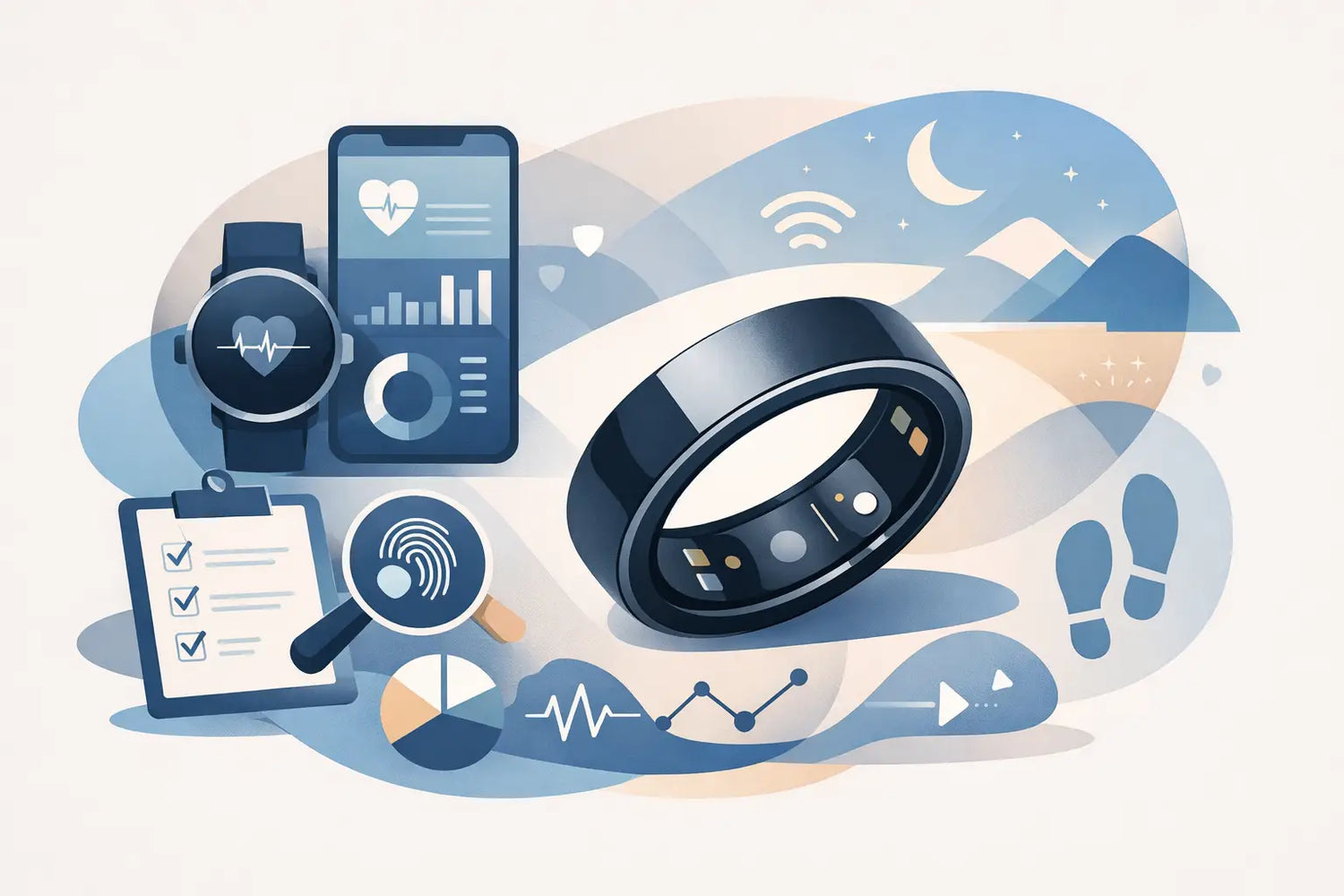
A ring can look elegant and still be annoying in everyday life. That is exactly why a good smart ring test is more than a quick look at design, app screenshots, or advertising promises. Anyone who wants to wear a smart ring day and night will very quickly notice whether the product really suits their habits—or only looks impressive in product photos.
For many, the smart ring is the more comfortable alternative to a smartwatch. No bulky display on the wrist, no sporty look that doesn't match every outfit, yet data on sleep, activity, and recovery right on the finger. But not every ring provides the same experience. In a smart ring test, therefore, the points that matter most in everyday life are comfort, battery life, measurement quality, app usability, and, of course, whether the purchase feels right without any risk.
Why a smart ring test is so relevant today
The market for smart wearables has grown, but so has the number of products that sound very similar. Almost every ring promises better sleep analysis, more control over your own health, and a discreet design. The difference only becomes apparent when you look closer.
A smart ring is not just worn during workouts. It accompanies meetings, the workday, sleep, travel, and relaxing evenings. That is exactly what makes it so attractive—and so demanding. A device that is worn around the clock must work discreetly. It must not be intrusive, it must not need to be charged constantly, and the app must not turn it into a science project.
So anyone who buys a smart ring is not simply buying a gadget. They are buying a daily system for better habits. That is why a smart ring test should always ask how well the ring fits into real life, not just which sensors are built in on paper.
Smart ring test: These criteria really matter
Many reviews get lost in technical details. They are not unimportant, but they are rarely the point at which you end up satisfied or annoyed. In everyday life, how it feels on the finger comes first.
Comfort is not a minor issue
A smart ring can only be useful if it is actually worn. It sounds simple, but it is the most important point of all. If the ring is too tight, it will be uncomfortable at night or leave pressure marks. If it is too loose, the measurements may become inaccurate, and the wearing experience will feel insecure.
This is especially noticeable with sleep tracking. A ring that you consciously feel at night will quickly end up on the bedside table. That is why the right size is crucial. Good providers reduce this risk with ring size guides, digital measuring tools, or free exchanges. This is not a small service extra, but a real purchasing advantage.
Sleep tracking must be easy to understand
Most people are interested in sleep first when it comes to smart rings. Not because they want to analyze every night like a laboratory report, but because they want to know in the morning how restful the night really was.
A good ring does not just show values; it makes them useful. How long did you sleep, how restful was the night, and how is your recovery developing over several days? Good apps create a clear picture from this. Bad apps provide numbers without context.
This is where a smart ring test deserves a closer look. It is not just about data collection, but about whether the analysis helps in everyday life. Anyone who looks at the app for two minutes in the morning wants clarity, not a flood of data.
Battery and charging must be suitable for everyday use
Many wearables fail not because of the technology, but because of small points of friction. If the battery is constantly empty or charging becomes a hassle, usage will quickly decline. This is even truer for smart rings than for watches, because you want to wear them continuously as much as possible.
A good model lasts for several days and can be charged without hassle. What matters is not just the manufacturer's maximum rating, but how reliably the battery performs in everyday life. Anyone who wants to regularly track sleep and activity needs a product that does not constantly demand attention.
The app and usability make the difference
The ring is only half the experience. The other half lies in the app. That is where you can see whether a product feels modern and helpful or unnecessarily complicated.
A good app quickly leads you to the relevant information. Sleep, activity, recovery, and trends should be clearly presented. If you have to search for a long time, you lose the added value. It is especially important that the usability works for people who are tech-savvy but do not want to analyze wearable data every day.
Design matters more than many admit
Smart rings are bought differently than classic trackers. Of course, it is about features, but also about style. A ring is visible on the hand. That is why it must suit everyday life—in the office, during sports, and when going out.
A smart ring test should therefore not treat design as superficial. If a ring looks high-quality and is easy to match with other items, the likelihood that it will really be worn every day increases. That is exactly when it delivers its benefits.
What reviews often overlook
Many reviews evaluate products according to a technical checklist. This is helpful, but not complete. Especially with a smart ring, there are factors that only become apparent after several days.
This includes, for example, routine. Does wearing it still feel comfortable after three nights? Is the app still motivating after two weeks? Does the ring remain discreet in everyday life, or does it become a nuisance when typing, working out, or washing your hands?
Trust also plays a major role. A wearable is not a spontaneous purchase like a phone case. Anyone who invests a higher amount wants to be sure that the size, usability, and quality are right. Offers such as free size assistance, exchanges for the wrong ring size, or a money-back guarantee trial period are therefore more than marketing. They remove exactly the hurdles that keep many people from buying.
Who a smart ring is particularly worth it for
Not everyone needs a smart ring. Anyone who primarily wants to read messages, answer calls, or look at a large display is often better served by a smartwatch. A ring is not a mini-smartphone. Its advantage lies elsewhere.
It is particularly well suited to people who want to integrate health discreetly into their everyday lives. Anyone who wants to improve their sleep, better understand their activity, and see trends in their own body awareness will find a ring to be a discreet solution. This is especially attractive for professionals or style-conscious users because the ring does not look like a piece of gym equipment.
It is also often the better choice for people who find watches uncomfortable while sleeping. But that does not automatically mean that every ring is comfortable. That is exactly why a careful comparison is worth it.
How to properly read a smart ring test
A convincing test does not just answer whether a ring is good, but who it is good for. That is an important difference. The best ring for intensive sports tracking is not necessarily the best ring for sleep, design, and everyday comfort.
Therefore, pay attention to concrete statements rather than general ratings. How does the ring fit in everyday life? How intuitive is the app? How easy is it to choose the right size? How secure is the purchase with returns or exchanges? Such questions are often more valuable than a single overall score.
If you want to minimize risk, a provider with clear service promises is usually the better choice. A 30-day trial period, free shipping, free exchanges for the wrong size, and fast support build trust before the ring even gets on your finger. Especially with a product that is worn personally, this makes a real difference.
The best smart ring test is ultimately your everyday life
On paper, a lot can look good. What matters is whether the ring provides data in the morning that you really understand, does not be intrusive during the day, and does not have to go back on the charger in the evening. That is where a nice gadget is separated from a product that you will use long-term.
Therefore, anyone who chooses a smart ring should not only compare features, but also the overall experience. Comfort, design, sleep tracking, the app, and purchase protection all go together. When all of these are right, technology becomes something very practical—a discreet companion that makes your health visible without making your everyday life more complicated.
So when you read the next smart ring test, pay less attention to big promises and more to the small details that count every day. That is where interest turns into real satisfaction.


Leave a comment
This site is protected by hCaptcha and the hCaptcha Privacy Policy and Terms of Service apply.