
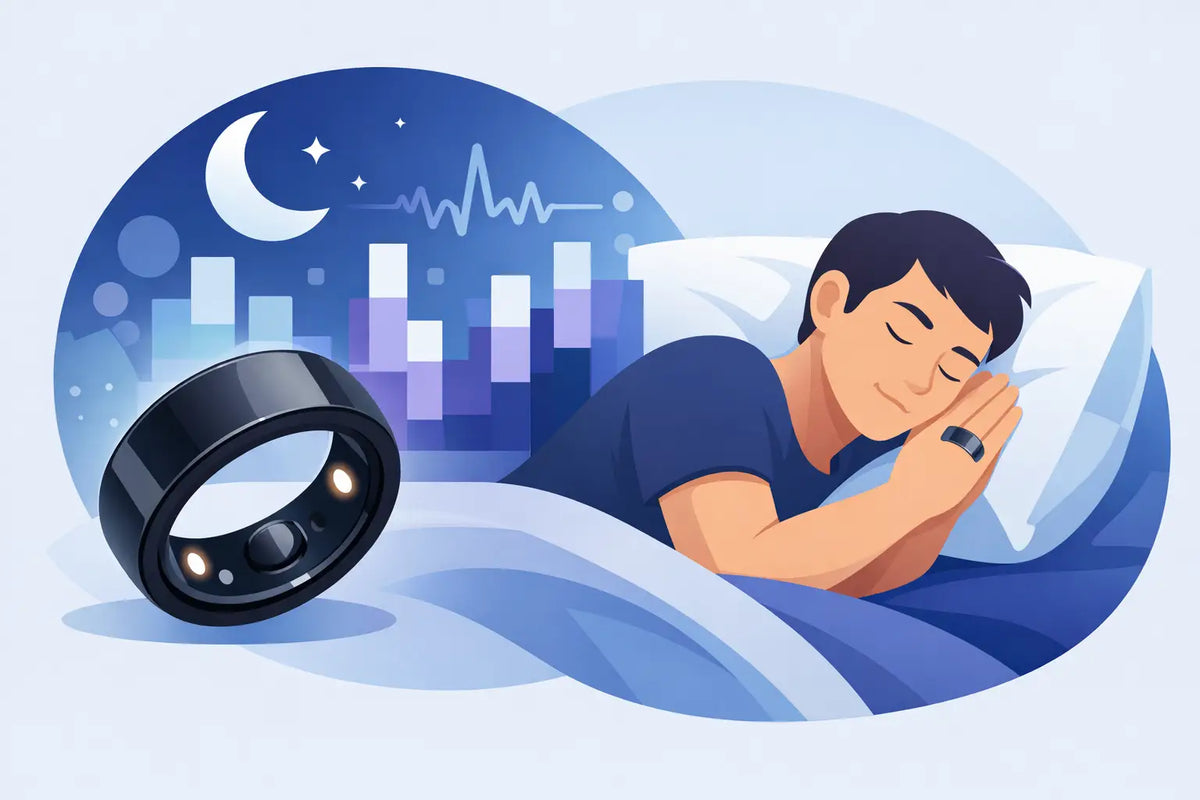
Do you sleep for eight hours and still wake up exhausted? Then not only the duration of your sleep matters, but also its quality. Can a smart ring detect sleep stages? Yes—modern smart rings can track sleep patterns, wakefulness, and estimated sleep stages. They are not a substitute for a sleep lab, but they provide practical insights into when your body truly gets its rest.
What a smart ring actually measures at night
A smart ring does not detect sleep stages by looking directly into your brain. A precise breakdown of deep sleep, REM sleep, and light sleep can only be achieved medically through a sleep study in a lab, where brain waves are recorded, among other things.
A smart ring works differently on your finger: It collects physiological signals throughout the night and analyzes them using algorithms. This produces an informed estimate of your sleep structure. Precisely because the ring is small, lightweight, and unobtrusive, many people prefer wearing it at night to a smartwatch. This is crucial, because good data starts with wearing the device regularly.
Typical measurements include your heart rate, heart rate variability, movement, breathing rate, and sometimes skin temperature. Together, these values show whether your body is more active, is calming down, or is currently in a restorative sleep phase.
Heart rate and heart rate variability
As you fall asleep, your heart rate usually drops. During deep rest phases, it often remains calm and steady. Heart rate variability, or HRV for short, describes the small time differences between heartbeats. It can provide clues about how well your body handles stress and recovery.
A smart ring combines these changes with the progression of the night. The result is not a medical judgment, but a clear picture: Was your night relatively peaceful? Were there many interruptions? How long did it take you to fall asleep?
Movement and rest periods
Even the smallest movements on your finger provide valuable clues. If you toss and turn frequently, get up briefly, or lie awake for a long time, the motion sensor detects this activity. This makes it particularly easy to identify wakefulness and falling asleep.
The important thing is: lying still does not automatically mean you are asleep. That is why a high-quality smart ring always combines movement data with heart and breathing metrics. Only this combination makes sleep analysis significantly more meaningful than measuring movement alone.
Breathing rate and temperature trends
Your breathing rate changes throughout the night. Skin temperature trends can also shift, for example due to exercise, alcohol, stress, a very warm bedroom, or the onset of a cold. Such values help the algorithm detect unusual nights and better assess your recovery.
A single outlier is rarely decisive. This data becomes interesting when you look at trends over several weeks. This is exactly where a smart ring shines: It accompanies you night after night without requiring you to change your behavior.
Which sleep stages can a smart ring detect?
Most sleep analyses divide the night into wakefulness, light sleep, deep sleep, and REM sleep. These categories are helpful as long as they are understood as estimates—not as minute-by-minute medical measurements.
Light sleep usually takes up the largest part of the night. It is the transition zone between wakefulness and deep rest. Deep sleep is associated with physical recovery: The body winds down, the heart rate is often low, and you are harder to wake. The REM phase is particularly active and is often associated with vivid dreams as well as the processing of emotions and experiences.
A smart ring can estimate these stages based on your measured signals. How accurate the values are for a single night depends on you, the ring model, and the measurement conditions. For your daily life, therefore, the question of whether every minute was perfectly categorized is not the deciding factor. What is much more helpful is: Do you recognize recurring patterns?
For example, if you regularly see more restlessness and less rest after eating late, long evenings in front of screens, or drinking alcohol, you have a concrete starting point. You do not have to guess which habit is good for you—you can observe changes over several nights.
How accurate is sleep stage detection on the finger?
A smart ring is very good at making sleep duration, approximate falling asleep time, wakefulness, and nighttime restlessness visible. When it comes to precisely distinguishing between light, deep, and REM sleep, it remains an algorithmic estimate. By the way, the same applies to most wearables on the wrist.
The data becomes particularly valuable when you use it comparatively. One night after a stressful day at work says very little. If, however, over two or three weeks you see that your resting heart rate is increasing, your falling asleep time is getting longer, and your sleep interruptions are increasing, a clear pattern emerges.
Not every deviation is a warning sign. Travel, heat, a late workout, or a restless evening can temporarily change your sleep. A smart ring is not meant to put pressure on you to optimize every night. It is meant to help you understand your body better and make it easier to maintain good habits.
In the case of severe, persistent symptoms such as pronounced daytime sleepiness, breathing pauses, heart palpitations, or chronically poor sleep, you should seek medical advice. Wearable data can be a helpful conversation starter, but it is not a substitute for a diagnosis.
So your smart ring reliably captures sleep stages
The best sensors are of little use if the ring does not fit correctly. It should sit securely on your finger without pinching or constantly rotating. If it is too loose, the optical sensor may capture unstable or incomplete signals. That is why the right ring size is more than just a matter of comfort.
Wear the ring every night if possible and do not just look at the morning score. Compare your values with your daily life: When did you drink coffee? How late was dinner? Did you exercise, work for a long time, or consciously take time to unwind? This is how numbers become insights you can actually use.
Your sleep environment also remains relevant. A dark, rather cool bedroom, regular bedtimes, and less screen time shortly before sleep are not new tricks—but they often work better than searching for the perfect measurement. The ring makes visible whether these small decisions actually make a difference for you.
Read sleep data correctly instead of letting numbers stress you out
Many users first look at the duration of deep or REM sleep. This is understandable, but it can lead you in the wrong direction. Sleep stages naturally fluctuate. If you fixate on a single value, you will quickly overlook the big picture.
Therefore, pay attention to three questions: Do you feel rested in the morning? Is your trend changing over several nights? And do the values match what is going on in your daily life? When all three points come together, sleep data becomes particularly useful.
A good sleep score is not a competition or a report card. It is a guide. Perhaps you will find that an evening walk improves your falling asleep time. Perhaps it will show that you still sleep soundly even after a late workout. Your data does not have to match the average—it is meant to fit you.
For whom is sleep analysis with a smart ring worth it?
A smart ring is particularly suitable for people who want to understand their sleep quality but do not want to wear a display on their wrist at night. Professionals with varying periods of stress, athletes in recovery phases, and anyone who wants to make their routines more conscious benefit from the discreet measurement.
The Fitorb™ Smart Ring Pro combines this unobtrusive form with sleep and activity data for everyday life. The important thing is not to turn every night into a data project. The important thing is to have the information so easily accessible that you can derive better decisions from it.
Your night does not have to be perfect to be valuable. If a smart ring shows you which habits give you more rest, better recovery, and a clearer feeling in the morning, a small measurement on your finger becomes a practical companion for your daily life.

Leave a comment
This site is protected by hCaptcha and the hCaptcha Privacy Policy and Terms of Service apply.