
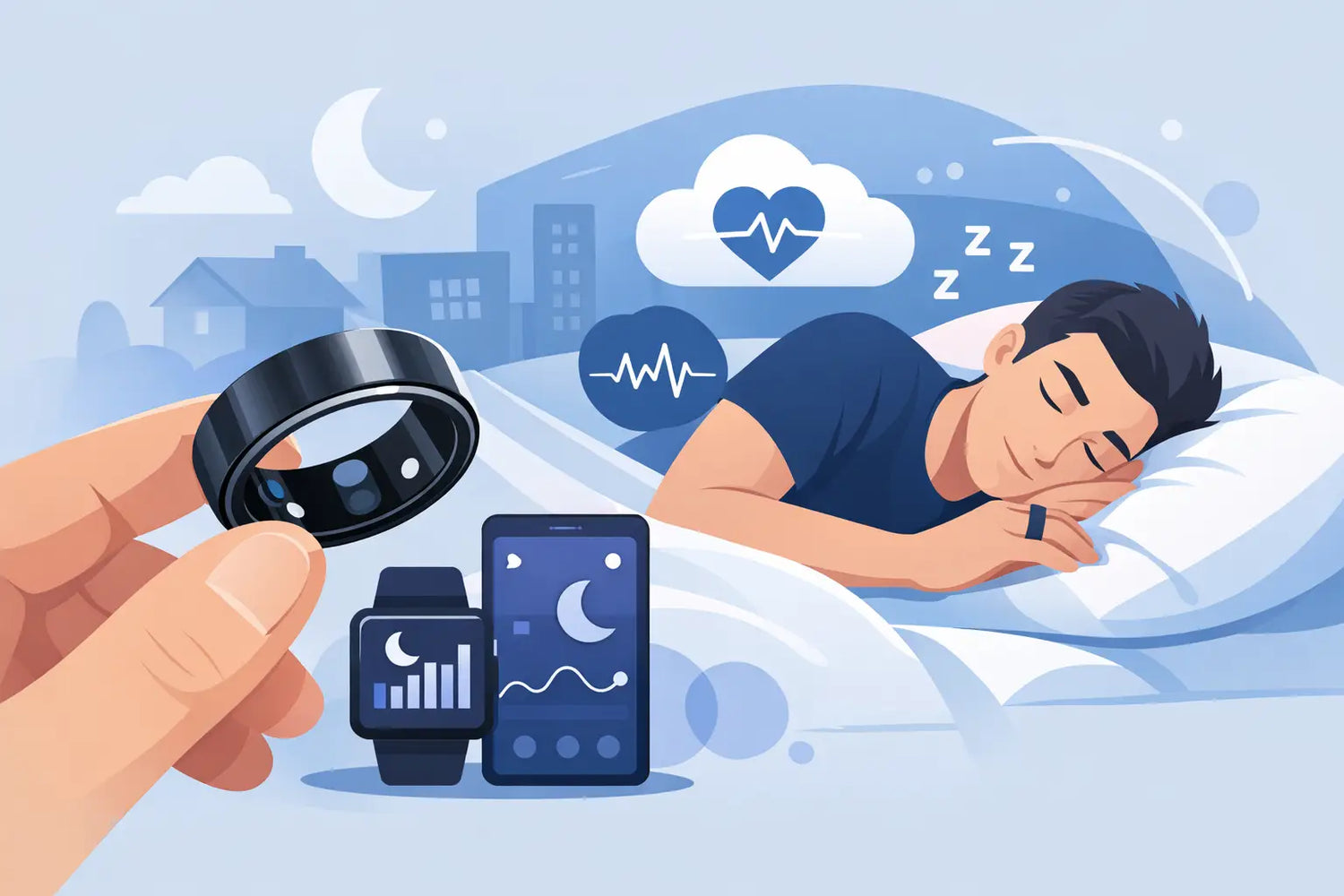
Anyone who wakes up tired in the morning, even though they had enough time to sleep, doesn't need more guesswork—they need clear data. This is exactly where a smart ring for sleep analysis becomes exciting: worn discreetly on the finger, barely noticeable at night and much more subtle than a smartwatch on the wrist.
For many, sleep is the first real aha moment in the world of wearables. Counting steps is nice. Understanding why you aren't rested despite spending eight hours in bed, on the other hand, changes your everyday life. Anyone who eats late in the evening, sleeps irregularly, or is accompanied by stress throughout the night can see not just a problem, but a pattern with the right metrics.
Why a smart ring for sleep analysis is in such high demand
Many people want to better understand their health without constantly wearing a technical device visibly on their body. That is exactly why the ring fits so well into everyday life. It doesn't stand out in a meeting, doesn't bother the wrist at night, and feels more like an accessory than a tracker.
There is also a practical advantage: certain body signals can be captured very closely and consistently on the finger. This is crucial for sleep analysis. A smart ring usually measures data such as heart rate, heart rate variability, movement, skin temperature, and, depending on the model, oxygen saturation. These values create a picture of how restful or restless the night was, how long you slept, and how well your body was actually able to recover.
That sounds technical, but in everyday life it is above all one thing: useful. Because good sleep data means little if it is presented in a complicated way. The key is that the evaluation remains understandable and provides concrete clues about routines, stress, and recovery.
What a good smart ring for sleep analysis should be able to do
Not every ring that looks good also provides reliable data during sleep. Anyone who wants to buy one should therefore not only look at the design or price, but at the interplay of sensors, wearing comfort, and the app experience.
The most important point is comfort at night. A ring can only measure effectively if it is worn regularly. If it is too heavy, too bulky, or doesn't fit properly, it will end up on the bedside table sooner or later. That is exactly why the right size is no minor detail, but a real purchasing factor.
Data processing is just as important. Good sleep analysis does not mean being overwhelmed with raw data. The app should clearly show when you fell asleep, how often you woke up during the night, how consistent your rest periods were, and how your sleep developed over several days. It becomes even more helpful when trends become visible. A single bad night says little. Five similar nights in a row say a lot.
Battery life also plays a bigger role than many think. If a wearable constantly needs to be charged, gaps are created in the data. This is particularly annoying for sleep analysis, because the night is often exactly what gets forgotten when the battery was already almost empty during the day.
Sleep data is helpful—but not infallible
An honest look at the topic is part of the package: No wearable replaces a sleep lab. A smart ring can provide very good clues, but cannot make a medical diagnosis. Anyone who notices severe sleep problems, breathing pauses, or persistent extreme exhaustion should have it checked by a doctor.
Nevertheless, these devices are valuable for everyday life. Not because they know everything perfectly, but because they make habits visible. Many users only realize through the data how strongly alcohol, late workouts, screen time, or irregular bedtimes affect sleep. This learning effect is often the greatest benefit.
So it is not about perfection, but about orientation. Anyone who uses their sleep analysis correctly does not chase every score, but recognizes connections. This makes the data practical for everyday life instead of stressful.
For whom is a smart ring more worthwhile than a smartwatch?
If you already like wearing a watch during the day, a smartwatch may be enough. Anyone who is looking for something lighter, more discreet, and more stylish at night will often end up with a ring. Especially with sleep, a compact format feels more comfortable because nothing presses on or bothers the wrist.
There is also the lifestyle factor. Many people want health tracking, but without the sporty look of classic fitness trackers. A smart ring fits better with business outfits, minimalist styles, and everyday situations where technology is not meant to be immediately visible.
This is exactly where the product concept becomes particularly attractive. A ring combines health data with a design that people like to wear. That may sound like a minor point, but it is crucial. Because the best wearable is not the one with the longest feature list, but the one you actually use every day and every night.
What you should look for before buying
Before buying, a quick reality check is worthwhile. Do you only want to see your sleep duration, or do you really want to understand how recovery, stress, and activity influence each other? If you are looking for the latter, the app, sensors, and wearing comfort should match.
You should also pay attention to service issues that are often underestimated. What happens if the ring size doesn't fit? Is there an easy size guide? Is an exchange uncomplicated? Especially with rings, this is more important than with watches because the fit directly influences the measurement quality. A good purchasing experience therefore does not end with the product, but begins with a reliable size determination.
Return options also build trust. Anyone trying a wearable for the first time does not want to feel like they are taking a risk. Transparent trial periods, easy support, and a hassle-free exchange remove exactly this hurdle. This is not a side issue, but a real advantage—especially for buyers who value comfort and security.
How to really get something out of sleep analysis
The biggest mistake is to only look at the data and then ignore it again. A smart ring only becomes valuable when the insights are translated into small decisions. This could mean going to bed three evenings earlier, skipping the late coffee, or observing how stress periods affect the night.
A simple approach is helpful here: do not change everything at once. Anyone who changes every habit at the same time will not realize in the end what really helped. It is better to adjust one thing for a few days and observe the development in the sleep tracking.
Working professionals benefit from this especially, because sleep often fails not due to a lack of knowledge, but due to routines. A ring does not provide a miracle solution, but clear feedback. And exactly this feedback is often the necessary impulse for good intentions to become real habits.
Design is not a bonus, but part of the product
Design is often underestimated with health wearables. Yet it is one of the deciding factors in whether a product is used long-term. A ring that looks high-quality and is comfortable to wear will not disappear in a drawer after two weeks.
That is why the combination of function and style is not a nice extra, but part of the benefit. Anyone who wants to wear their health on their finger does not want bulky technology, but a product that fits into everyday life. That is exactly where the strength of modern smart rings lies: they provide data without looking like a medical device.
For many, this is the real reason for switching. Less visible, more comfortable when sleeping, better suited to personal style. If a clear app and a secure purchasing process are added to that, interest quickly turns into a decision.
A model like the Fitorb Smart Ring Pro addresses exactly this expectation: health tracking that does not look complicated, but remains wearable, clear, and practical for everyday life.
When buying is particularly worthwhile
A smart ring for sleep analysis is especially worthwhile if you not only value your well-being but also want to understand it better. If you notice that energy, focus, and recovery fluctuate, but the cause remains unclear, reliable sleep data can be a very concrete starting point.
It is also worthwhile if you are not interested in visible technology on your wrist. For many, that is exactly the difference between "interesting" and "really suits me." The ring is more discreet, more elegant, and often more comfortable to wear—especially at night.
In the end, it is not about making every night perfect. It is about recognizing patterns, making smarter decisions, and choosing a product that you like to wear. If health is meant to fit into everyday life without complications, the right ring is often not a gadget, but an amazingly practical start.


Leave a comment
This site is protected by hCaptcha and the hCaptcha Privacy Policy and Terms of Service apply.