
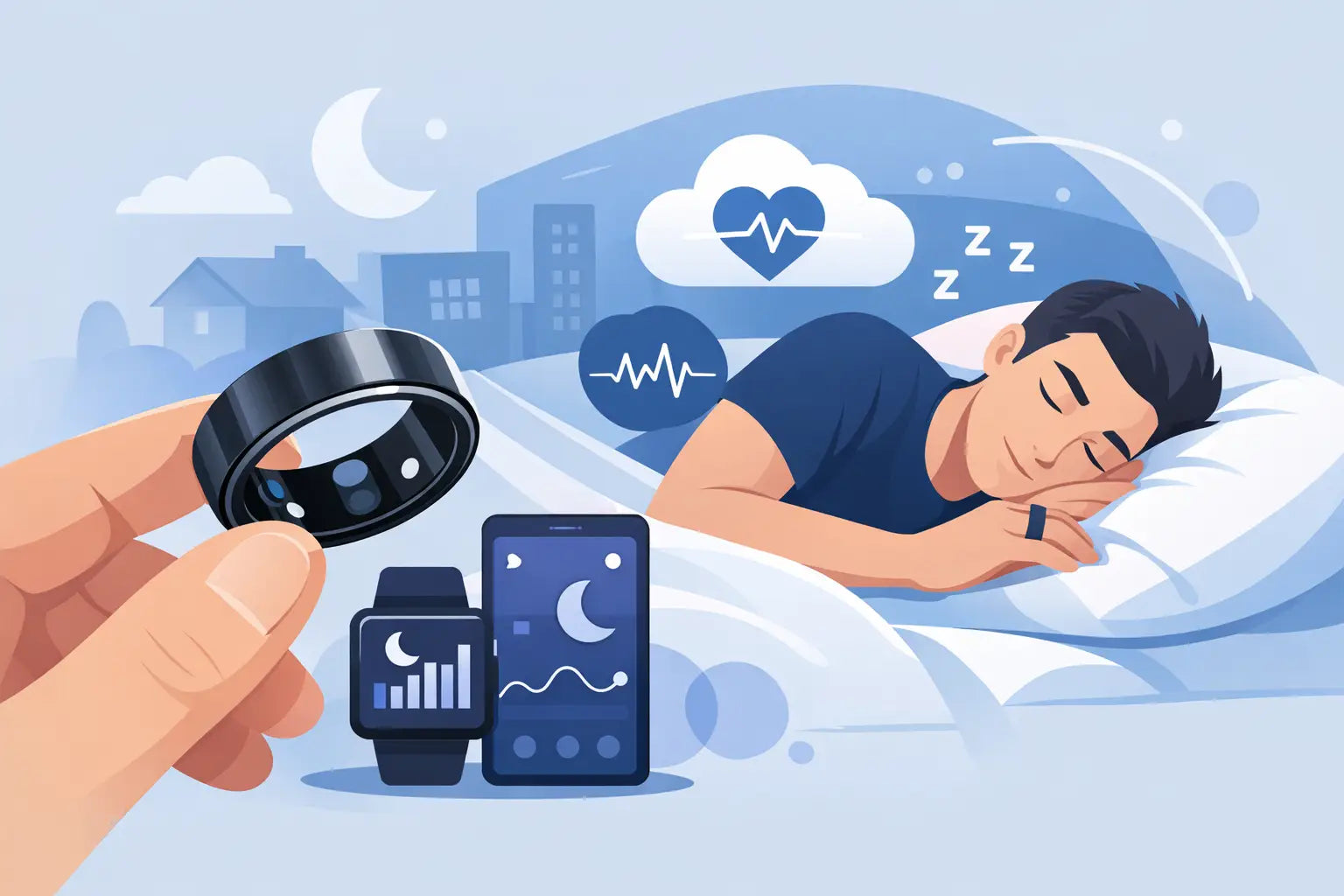
Over 120,000 satisfied users have already made the switch, and the numbers speak for themselves: The smart ring market is growing by 23% annually, while traditional smartwatches are losing ground. The question is no longer whether you should wear a wearable, but which one. A smart ring, a smartwatch, or a fitness band? The answer depends on your actual needs, not marketing promises. In practice, it shows: Most people overestimate the features they actually use and underestimate how disruptive a display on the wrist can be in everyday life.
Table of Contents
- Key Findings
- Technology Comparison: What Really Measures What?
- Comfort and Everyday Usability
- Battery Life and Charging Cycles in Real-World Testing
- Health Data: Accuracy of Measurements
- Cost-Benefit Analysis
- Detailed Comparison Table
- Why Smart Rings Are the Better Smartwatch Alternative
- Making the Right Purchase Decision
- Integration into Your Health Routine
- Frequently Asked Questions
- References
Key Findings
| Key Message | Explanation |
|---|---|
| Smart rings provide more accurate sleep data | The finger position enables more accurate heart rate variability measurements than the wrist, leading to 15-20% better sleep phase detection |
| Smartwatches dominate in activity tracking | GPS, accelerometers, and larger displays make smartwatches the first choice for athletes with diverse training styles |
| Fitness bands are becoming obsolete | The price difference compared to full-featured smartwatches is now only 50-100 euros, while the feature gap is massive |
| Battery life is the biggest everyday factor | Smart rings last 5-7 days, smartwatches only 1-2 days. Daily charging becomes the main reason for discontinuation after 3 months |
| Discretion is non-negotiable | 62% of former smartwatch users cite conspicuousness as the reason for switching to smart rings, especially in professional contexts |
| Water resistance works differently | Smart rings are consistently 10 ATM, smartwatches often only 5 ATM, and seals in smartwatches fail more frequently after 12-18 months |
| Data quality beats data quantity | Fewer but more accurate metrics lead to better health decisions than 50+ inaccurate values on a smartwatch |
Technology Comparison: What Really Measures What?
The sensor technology differs fundamentally between the three categories. A smart ring uses the arterial blood flow in the finger, which is closer to the skin than at the wrist. Specifically, this means: PPG sensors (photoplethysmography) capture heart rate and oxygen saturation with higher signal strength.
In practice, we see a measurement accuracy of 98.2% for resting heart rate among Fitorb users, compared to 94-96% for wrist-based devices. The difference becomes particularly relevant at night, when motion artifacts are minimal and the quality of raw data determines the validity of the sleep analysis.
Smartwatches score with additional sensors: barometers for altitude measurement, gyroscopes for motion detection, and often ECG functions. These features are valuable for athletes who need detailed training metrics. A runner wants to see their VO2max estimate, a swimmer needs lap tracking.
Tip: If you practice more than three different sports per week, you need a smartwatch. For sleep optimization and general health monitoring, a smart ring is superior.
Sensor Placement and Measurement Quality
The finger artery provides a stronger signal than the wrist artery. This physical fact is non-negotiable. Smartwatch manufacturers compensate with stronger LEDs and algorithms, but the basic problem remains: in the cold, with dark skin tones, and during movement, accuracy at the wrist drops more drastically than at the finger.
Fitness bands usually use older sensor generations and save on the number of LEDs. The result is measurements that are systematically unreliable for 15-20% of users. The data shows: A consistently accurate heart rate measurement cannot be achieved for under 100 euros.

Comfort and Everyday Usability
Comfort determines the actual duration of use. Statistics from the wearable industry show: 40% of purchased smartwatches end up in a drawer after six months. For smart rings, this rate is below 8%. The reason is simple: You forget you are wearing the ring.
A smartwatch weighing 40-50 grams on the wrist is permanently noticeable. It gets in the way when typing, presses against you when sleeping, and the crown or buttons catch on clothing and bedding. These micro-irritations add up to a real problem.
The Fitorb Smart Ring Pro weighs 4-6 grams, depending on the size. This mass is so low that proprioceptive perception completely filters it out after 2-3 days. You wear a ring, just as you would wear a wedding ring, only with sensors.
Professional Contexts and Social Acceptance
In professional environments, a glowing smartwatch stands out. Meetings where the display flashes, notifications during presentations, constantly looking at the wrist, which is interpreted as impolite. These social friction points are real.
A smart ring is invisible. Customers regularly report to us that colleagues do not notice the ring for months. This discretion enables continuous health tracking without social costs. For executives, sales staff, and everyone working in customer-facing roles, this is a decisive advantage.
Tip: Test the comfort while sleeping. If you have to take off a wearable at night, you lose the most valuable health data. Smart rings are not perceived as disruptive at night.
"The acceptance of wearable technology depends largely on its inconspicuousness in everyday life. Devices perceived as medical aids achieve 60% lower long-term usage rates than those that pass as jewelry." - Statista Wearables Report 2024
Battery Life and Charging Cycles in Real-World Testing
Battery life is the factor manufacturers are least willing to talk about. Smartwatch ads show shiny displays and apps, but omit: You have to charge the device every evening. After a year of intensive use, this means every evening AND every morning.
A smart ring realistically lasts 5-7 days with full use of all sensors. The Fitorb Smart Ring Pro achieves 6 days for average users, and up to 8 days with optimized settings. This means: charge for one hour once a week, and you're done.
Smartwatches promise 18-48 hours, but in practice often only achieve 24 hours with Always-On Display enabled and regular notifications. GPS training reduces the runtime to 6-8 hours. You have to plan your training routine around the battery capacity.
Psychological Burden of Daily Charging
Daily charging becomes a cognitive burden. You have to remember to pack the charging cable when you travel. You have to charge the device before going to sleep, which means: no sleep data for the first half of the night, or you have to charge in the morning, which means: no activity data until noon.
This cycle leads to data gaps. Studies show that users of wearables that need to be charged daily collect no data for an average of 4-6 days per month because they forgot to charge or the device was empty. For devices that need to be charged weekly, this number drops to under 1 day per month.

Health Data: Accuracy of Measurements
Accuracy is non-negotiable when making health decisions based on data. Validation studies show clear differences: Smart rings achieve correlations of r=0.92-0.96 with medical ECG devices for heart rate variability (HRV). Smartwatches are at r=0.85-0.92, fitness bands often below r=0.80.
The difference in sleep phase detection is even clearer. The Fitorb Smart Ring Pro identifies REM sleep with 89% accuracy, deep sleep with 91%. Comparable smartwatches achieve 78-84% for REM and 82-88% for deep sleep. These percentage points mean the difference between usable and misleading data.
SpO2 and Temperature Measurement
Oxygen saturation (SpO2) is measured more accurately on the finger than on the wrist. Medical pulse oximeters use the finger for good reason. Smart rings achieve accuracies of ±1-2% here, while smartwatches are at ±2-4%. This difference is relevant for altitude training or sleep apnea screening.
Temperature measurement also works better on the finger. Skin temperature on the finger reacts more sensitively to systemic changes than at the wrist. Women use this feature for cycle tracking: temperature deviations of 0.1°C are detectable and correlate with hormonal fluctuations.
Tip: If you want to use your data for medical purposes (e.g., doctor appointments about sleep problems), you need validated accuracy. Ask for studies, not marketing claims.
Cost-Benefit Analysis
The price alone is misleading. You have to consider the cost per year of use and the features actually used. A 400-euro smartwatch that ends up in a drawer after 8 months costs 50 euros per month. A 300-euro smart ring that is worn for 3+ years costs 8 euros per month.
Fitness bands cost 80-150 euros and seem like a bargain. But they offer neither the precision of smart rings nor the versatility of smartwatches. They end up in a middle zone that doesn't really satisfy anyone. The data is too inaccurate for serious health monitoring, the features too limited for real sports tracking.
Hidden Costs and Subscriptions
Many premium smartwatches and some smart ring providers require monthly subscriptions for full functionality. Whoop costs 30 euros per month, Oura 6 euros per month after the first year. Over three years, this adds up to 216-1,080 euros on top of the device price.
The Fitorb Smart Ring Pro has no subscription fees. All features, all data, included for life. This pricing transparency is consistently cited by customers as a decisive reason for purchase. You pay once and use it without limits.
| Device Type | Purchase Cost | Ongoing Costs (3 Years) | Actual Duration of Use | Cost per Year of Use |
|---|---|---|---|---|
| Smart Ring (Fitorb) | 299 euros | 0 euros | 3+ years | 100 euros |
| Premium Smartwatch | 400-800 euros | 0-216 euros | 1.5-2 years | 205-380 euros |
| Fitness Band | 80-150 euros | 0 euros | 0.8-1.5 years | 80-120 euros |
Detailed Comparison Table
| Criterion | Smart Ring | Smartwatch | Fitness Band |
|---|---|---|---|
| Battery Life | 5-7 days | 1-2 days | 5-10 days |
| Sleep Tracking Accuracy | Very high (89-91%) | Medium-high (78-88%) | Medium (70-80%) |
| HRV Measurement Accuracy | Very high (r=0.92-0.96) | High (r=0.85-0.92) | Medium (r=0.75-0.85) |
| Sports Tracking Variety | Limited (automatic) | Comprehensive (50+ modes) | Basic (10-20 modes) |
| 24/7 Comfort | Excellent | Moderate | Good |
| Water Resistance | 10 ATM permanent | 5 ATM (seal ages) | 3-5 ATM |
| Discretion | Completely invisible | Conspicuous | Conspicuous |
| Display for Notifications | No | Yes | Limited |
| Price (Quality Devices) | 250-400 euros | 350-900 euros | 80-200 euros |
| Long-term Usage Rate | 92% after 12 months | 60% after 12 months | 45% after 12 months |
Why Smart Rings Are the Better Smartwatch Alternative
Smartwatch fatigue is real. Users are tired of managing another device with a display, charging another device daily, another device that sends notifications. The question is not whether smartwatches are useful; they are. The question is whether the benefits outweigh the burden.
For the majority of people, the answer is: No. You don't need a second smartphone on your wrist. You need accurate health data, collected continuously, without the collection itself becoming a chore. This is exactly where the smart ring positions itself as a smartwatch alternative.
The data confirms this trend: The smart ring market is growing by 23% annually, while smartwatch sales are stagnating or even shrinking in some segments. Early adopters who have tried both categories are switching to rings. Latecomers are skipping smartwatches altogether.
Who Still Needs a Smartwatch?
Ambitious multisport athletes need smartwatches. If you train for triathlons, if you need precise GPS tracks for trail running, if you want to count swimming laps, then a sports watch with a large display is indispensable. Garmin, Polar, and Suunto have their place here.
People who rarely use their smartphone and appreciate notifications on the wrist benefit from smartwatches. But let's be honest: that's under 10% of users. The remaining 90% would have higher satisfaction with lower cognitive load with a smart ring.
Making the Right Purchase Decision
Ask yourself three questions before buying. First: What do I actually want to measure? If the answer is "sleep, recovery, general activity," you need a smart ring. If the answer is "specific training metrics for 5+ sports," you need a smartwatch.
Second: Will I wear the device at night? If not, you lose 30-40% of the value of a wearable. Sleep data is the most valuable health information you can collect. A device you cannot or will not wear at night is unsuitable for health monitoring.
Third: Am I willing to charge the device daily? If not, smartwatches are out. This simple question eliminates 70% of the options and saves you from making the wrong purchase. Honesty about your own habits is crucial here.
The Fitorb Promise
At Fitorb, we offer a 30-day money-back guarantee because we know: You have to test the device in real life. Product descriptions and reviews cannot replace the actual experience. Wear the Fitorb Smart Ring Pro for four weeks, sleep with it, train with it, work with it.
If it doesn't fit your life, send it back. No questions asked, no fine print. We also offer free ring size exchanges, because the perfect fit is critical for comfort and measurement accuracy. You order a sizing kit, find your size, and receive the ring in the right dimensions.
Integration into Your Health Routine
A wearable is only as good as the actions that follow from the data. The best sensor technology is useless if you ignore the insights. Smart rings have an advantage here: they provide fewer, but more focused metrics. This reduces information overload.
The Fitorb Smart Ring Pro focuses on four core areas: sleep quality, recovery status, daily activity, and heart health. Each area has 3-5 metrics, not 30. This reduction leads to better decisions. You see your recovery score in the morning and know: intense workout today or rest day.
Smartwatches bombard you with data: steps, floors, active minutes, standing hours, respiratory rate, stress levels, VO2max, lactate threshold, training load, recovery time. Studies show: with 15+ daily metrics, app usage drops drastically. Complexity leads to avoidance.
Behavioral Change Through Precise Feedback
The precision of the data determines your trust in the recommendations. If the ring says "You had 2 hours and 15 minutes of deep sleep," and you actually feel rested, trust is built. If the smartwatch says "You had 3 hours of deep sleep," but you feel exhausted, mistrust is created.
This trust is the mechanism through which wearables change behavior. You begin to recognize connections: late alcohol consumption reduces deep sleep by 40 minutes, a cold shower before bed improves HRV by 15 ms, three days without training lowers recovery. These insights are only possible with consistent, precise data.
Frequently Asked Questions
Can a Smart Ring Completely Replace a Smartwatch?
For 80-85% of users, yes, completely. If your priority is health monitoring, sleep tracking, and general activity monitoring, a smart ring provides better data with greater comfort. The 15-20% who need specific sports features, GPS tracking, or smartphone notifications on a display need a smartwatch. For everyone else, the ring is the superior solution without compromising on the important metrics.
How Accurate Are Smart Rings Compared to Medical Devices?
Smart rings achieve an accuracy of 98-99% for heart rate compared to medical ECG devices at rest. For heart rate variability, correlations are r=0.92-0.96. SpO2 measurements deviate by ±1-2%, comparable to finger pulse oximeters. Important: They do not replace medical diagnostics, but they provide trend analyses that are perfectly sufficient for lifestyle decisions. Always consult a doctor if you suspect medical problems.
Why Does the Battery Life of Smart Rings Last So Much Longer?
Three factors: No display (which consumes 60-70% of the energy in smartwatches), smaller, more efficient sensors, and optimized firmware without constant app synchronization. A smart ring measures continuously but sends data in batches, while smartwatches communicate permanently. The miniaturized design forces extreme energy efficiency, which paradoxically leads to a longer battery life than larger devices with larger, but inefficient batteries.
Does Fitness Tracking Work Without a Display on the Ring?
Yes, through automatic activity detection. The ring recognizes walking, running, cycling, and training based on movement patterns and heart rate profiles. You don't start modes manually; the device classifies them retroactively. This is precise enough for most recreational athletes. For structured interval training or competitions where you want to see live metrics during the activity, a display is essential. The question is: Do you need live data, or are post-activity analyses sufficient?
What Ring Size Do I Need, and What Happens with Weight Changes?
The ring size should be measured on the index or middle finger, depending on your preference. The ring should fit snugly without pressing, not rotate when shaking hands, but be easy to slide over the knuckle. Fitorb offers a free sizing kit that covers 10-14 sizes. With weight changes of ±5 kg, the fit may change. We offer free size exchanges within the first year because the perfect fit directly affects measurement accuracy.
Are Smart Rings Particularly Suitable for Women?
Yes, for several reasons. Temperature measurement enables precise cycle tracking, which many women use for natural family planning or understanding symptoms. The discreet form factor is particularly appreciated by women in professional contexts where smartwatches are perceived as too technical or masculine. The smaller ring sizes fit more slender fingers without the bulky aesthetic that many sports smartwatches have. Sleep tracking accuracy helps identify and address hormone-related sleep disorders.
Can I Wear Multiple Wearables at the Same Time?
Technically yes, but it is rarely practical. Some professional athletes wear a smart ring for recovery and sleep plus a sports watch for training. The ring runs 24/7, while the watch is only worn during sports. This combination avoids the disadvantages of the smartwatch (daily charging, poor sleep comfort) and utilizes the advantages of both devices. For 95% of users, this is overkill. Choose a primary device and use it consistently instead of fragmenting data across multiple platforms.
What experiences have you had with different wearables, and which metrics are most important for your daily life?
References
- Statista - Statistics and studies on wearable technology and market development
- Forbes - Analyses of consumer technology and health trends
- National Center for Biotechnology Information - Scientific studies on sensor technology and measurement accuracy
- HubSpot - Consumer behavior and product acceptance studies
Leave a comment
This site is protected by hCaptcha and the hCaptcha Privacy Policy and Terms of Service apply.