
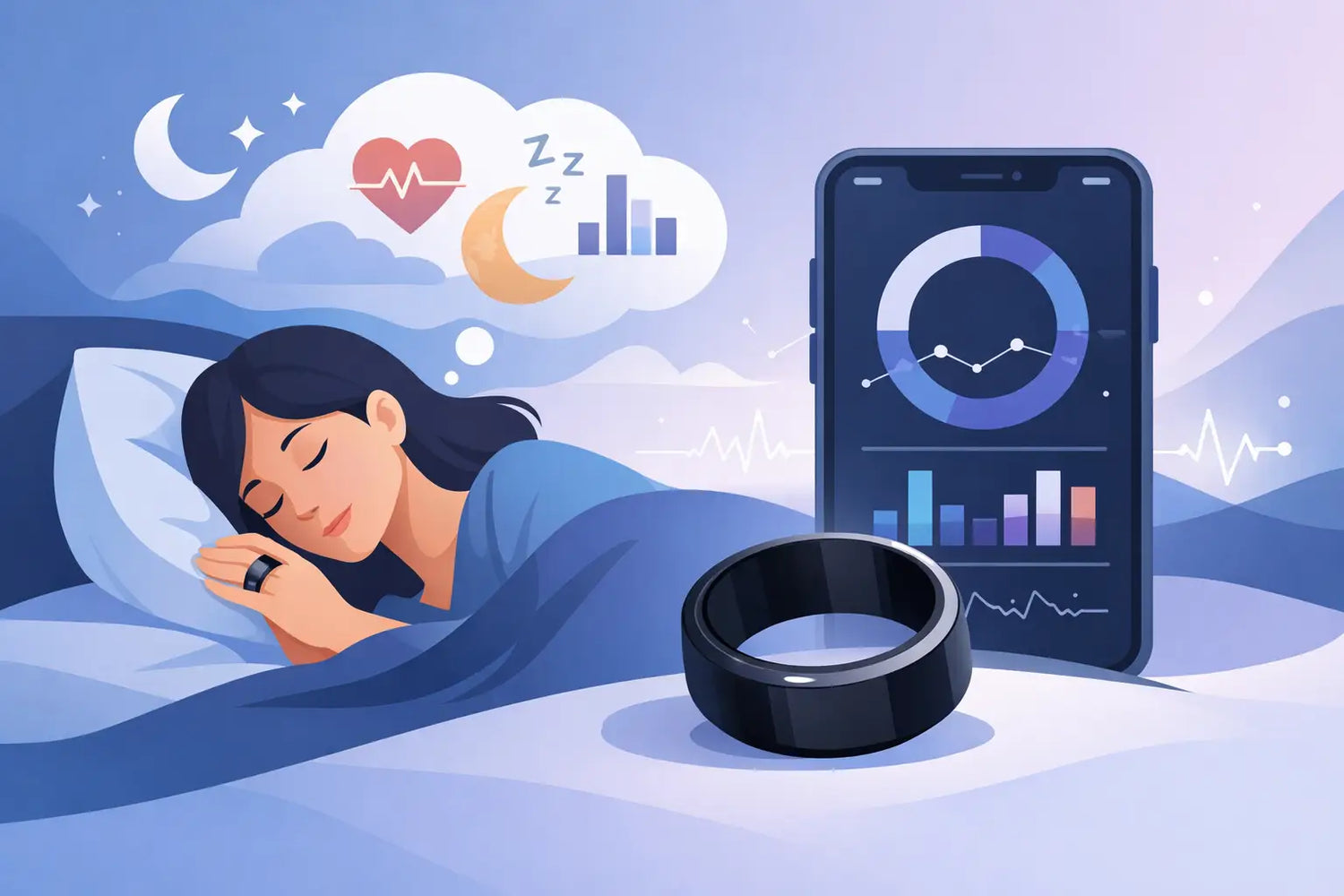
Anyone who has slept long enough in the morning yet still feels exhausted usually doesn't have a motivation problem—but an information problem. This is exactly where the topic of improving sleep quality with a ring can get interesting: not because a ring magically fixes sleep, but because it makes visible what really happens at night and is often overlooked during the day.
For many, a smart ring is the more comfortable alternative to a smartwatch. No glowing display on the wrist, no bulky feeling in bed, no constant technological signal before falling asleep. Instead, the technology sits discreetly on the finger and collects exactly the data that can help to better understand sleep: sleep duration, rest phases, heart rate, nighttime movement, and, depending on the model, trends related to recovery and exertion.
Improving sleep quality with a ring—what does it really offer?
The short answer: A ring does not automatically improve sleep, but it can create the foundation to make targeted changes. Many people misjudge their sleep. They think they sleep for eight hours, but wake up several times. Or they feel exhausted even though the total duration looks good. Only when you recognize patterns do meaningful adjustments become possible.
The greatest advantage, therefore, lies not only in tracking, but in the combination of comfort and consistency. A device that you enjoy wearing provides regular data. And regular data is significantly more valuable than a single "bad night" that leaves you wondering why. Anyone who wants to understand why some evenings end restoratively and others do not does not need complicated laboratory diagnostics for everyday life—but reliable trends.
For many professionals, this is exactly the point. Between meetings, training, late meals, and screen time, it quickly becomes blurred what has a positive or negative effect on sleep. A ring does not eliminate these factors, but it often shows more clearly which habits come at a price.
Why a ring is often a better fit than a watch
When it comes to sleep, not only technology matters, but also wearability. A smartwatch can be practical during the day, but at night it bothers some users due to its size, weight, or the feeling of constantly having a gadget on their arm. A ring feels more discreet. This is no small detail, but often the difference between "I'll try it" and real long-term use.
Especially with sleep tracking, comfort counts more than features on paper. Anyone who regularly takes off a wearable at night gets incomplete data. Anyone who wears it continuously recognizes developments over weeks. That is why the ring format is attractive to people who want to track health in everyday life without having to adapt their style or their sleep experience to technology.
In addition, there is the lifestyle factor. A smart ring looks more like jewelry than a fitness device. For many, this is exactly what matters, because health monitoring today should not only work, but also fit into everyday life.
Which data really helps—and which you should not overrate
Anyone who wants to improve their sleep quality with a ring should not get lost in every metric. Values that show trends are particularly helpful. Sleep duration is a start, but not yet the whole story. It gets more interesting when resting heart rate, falling asleep times, nighttime restlessness, and recovery values are viewed over several nights.
For example: If the resting heart rate is regularly higher on late evenings when eating and sleep appears more restless, that is a useful clue. If deep sleep drops after alcohol or recovery is worse after intensive training, a guess becomes a pattern. That is exactly where the added value lies.
It is less helpful to view every night like an exam. Sleep data are not school grades. Individual outliers are normal. Stressful days, travel, heat, or a late event change the values. Anyone who immediately problematizes every deviation is more likely to put additional pressure on themselves. It is more useful to look at the course over two to four weeks.
How tracking becomes real improvement
The ring provides data, but better nights only arise from concrete decisions. The first lever is often bedtime. Many people do not go to bed too late because they don't know any better, but because their evening has no fixed structure. If the ring shows that irregular falling asleep times coincide with worse values, that is usually the most direct starting point.
The second lever is evening exertion. Late, intensive training can work well for some, but keep others' bodies active for too long. The same applies to heavy meals, alcohol, or long scrolling in bed. A smart ring does not replace self-observation, but it makes connections more measurable.
The third lever is recovery throughout the day. Anyone who is permanently stressed often takes this tension into the night. This is exactly where wearables are interesting, because they do not just look at sleep in isolation, but at the relationship between activity, recovery, and exertion. This helps to see sleep not as an isolated problem, but as the result of the entire day.
For whom a smart ring is particularly worthwhile
A ring is particularly useful for people who want to improve their sleep without completely turning their lives upside down. It is a good fit for professionals who make many data-driven decisions and have no desire for inaccurate gut feelings. It is also ideal for anyone looking for a discreet, stylish alternative to a smartwatch.
Anyone who already reacts very sensitively to body data should approach its use with a bit more awareness. For some, numbers motivate; for others, they create pressure. In that case, it helps not to check the app constantly, but to evaluate patterns once a day or every few days. The best technology is of little use if it increases inner restlessness.
Expectations should also remain realistic. A ring does not diagnose medical sleep disorders. Anyone who snores heavily, suspects sleep apnea, or is permanently exhausted should have their symptoms checked by a doctor. Smart wearables are great for orientation, habits, and everyday trends—not for replacing professional diagnostics.
What matters when buying
When sleep tracking is the focus, three things are crucial: wearing comfort, data clarity, and everyday usability. A ring must not bother you at night. It should be light, fit well, and function so simply that you do not have to pay constant attention to it.
The presentation of the data is just as important. Many users do not need complicated raw values, but clear indications of what the results mean. Good systems help to recognize patterns instead of just collecting numbers. That is exactly what makes the difference between a nice toy and a product you use long-term.
Then there is the practical purchasing side. Ring size is a real factor with smart rings, because a poor fit quickly worsens the experience. A digital ring-sizing tool, uncomplicated size exchange, and a risk-free trial period create significantly more certainty here. Anyone who buys online does not want to guess, but to be able to decide with confidence.
That is exactly why a product only seems convincing when technology, design, and service work together. The Fitorb Smart Ring Pro hits exactly this nerve: elegant enough for everyday life, smart enough for meaningful sleep data, and simple enough to make health monitoring truly wearable.
Improving sleep quality with a ring—but please without perfection pressure
The biggest mistake with sleep tracking is not a lack of discipline, but misplaced ambition. Poor sleep does not automatically get better just because you measure it. It gets better when the data leads to small, realistic changes. Wind down 20 minutes earlier every evening. Don't treat the late glass of wine as a routine. Make the last hour before bedtime a bit calmer. Often, that is all it takes for noticeable differences.
A smart ring is therefore not a miracle cure, but a clever companion. It is particularly well suited to people who want to integrate health elegantly into their everyday lives without immediately living with a high level of technological effort. Anyone who wants to understand what really happens at night gets a quiet but useful advantage on their finger.
In the end, it is not about collecting perfect sleep values, but about feeling more rested in the morning—and that is exactly where a ring becomes truly interesting.

Leave a comment
This site is protected by hCaptcha and the hCaptcha Privacy Policy and Terms of Service apply.