
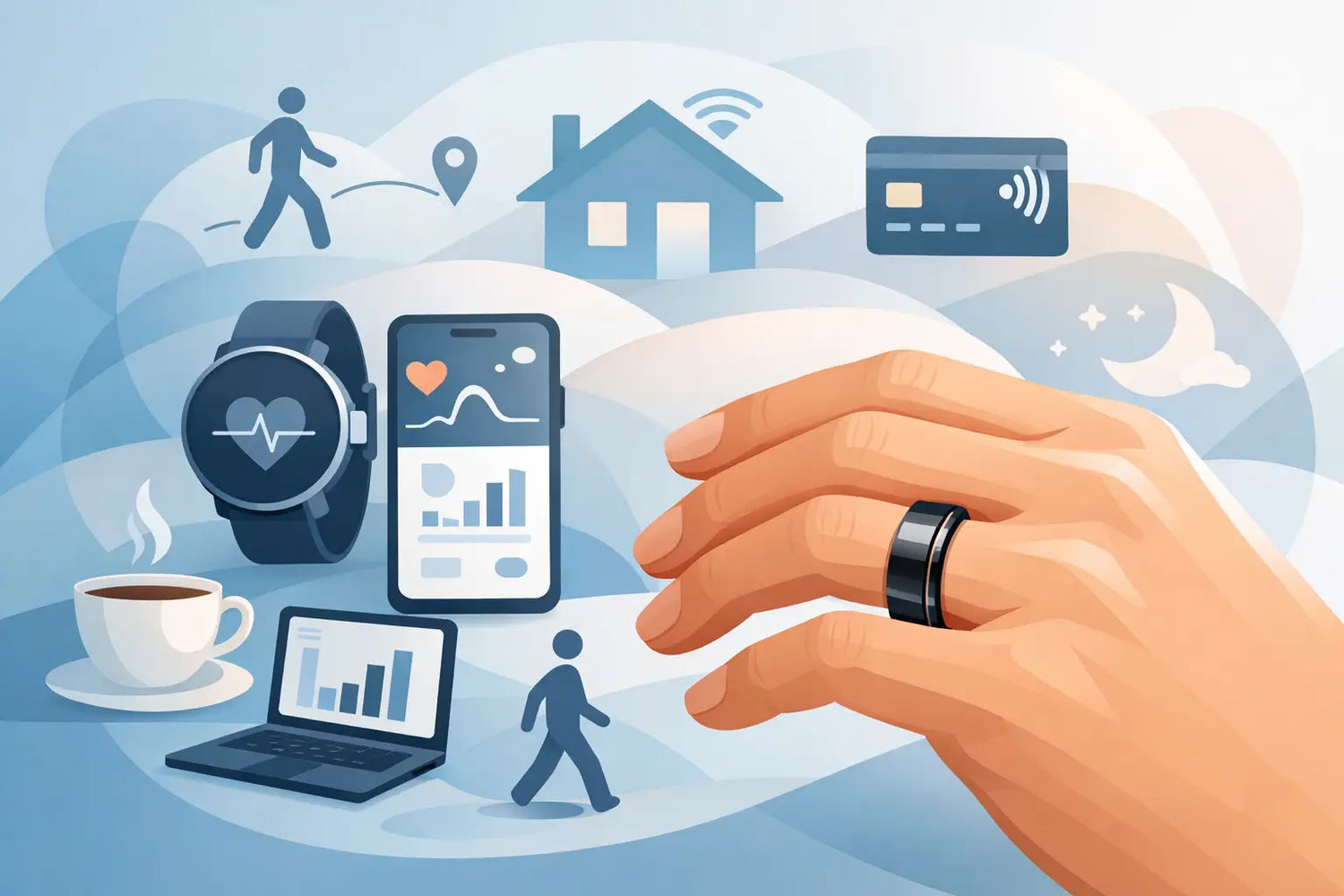
Quickly check your sleep in the morning, keep an eye on your steps and activity during the day, and better assess your stress levels in the evening—that’s exactly why a smart ring is exciting for everyday use. Not as a tech toy that ends up in a drawer after a week, but as an unobtrusive companion that provides data without disrupting your look or routine.
Anyone who has worn a heavy smartwatch at night knows the difference immediately. A ring is barely noticeable on your finger. It doesn’t look sporty or intrusive, fits in the office, restaurant, and gym, and remains comfortable even when you want to forget you’re wearing a wearable. That’s exactly where its great advantage lies: good health technology works best in everyday life when it doesn’t constantly demand attention.
Why a smart ring is such a good fit for everyday life
Many wearables fail not because of the technology, but because of reality. A watch has to be charged, styled, and often consciously worn. A ring is much more discreet. It fits into your daily routine instead of dominating it.
For many people, this isn’t just a detail—it’s the deciding factor. Anyone who wants to appear professional at work, prefers minimalist jewelry, or doesn’t want to wear anything bulky on their wrist at night is usually not looking for a flashy fitness watch. They are looking for a solution that looks elegant while still capturing the most important health data.
A smart ring for everyday use fills exactly this gap. It combines a compact design with features that have become essential for many today: sleep tracking, activity data, heart rate monitoring, and a better sense of how resilient your body really is at the moment.
What a smart ring really brings to everyday life
The greatest benefit is rarely found in a single number. It’s more about patterns. If you see that your sleep regularly deteriorates after late meals or that restless nights are directly linked to lower energy levels during the day, a mere collection of data becomes genuine insight.
In everyday life, this is especially helpful for people who don’t want to rely on their gut feeling. They want to understand why they wake up feeling fit or unfit in the morning. They want to better assess exercise, rest, and work stress. A ring makes this effortlessly accessible. It measures in the background and provides insights without you having to actively start anything.
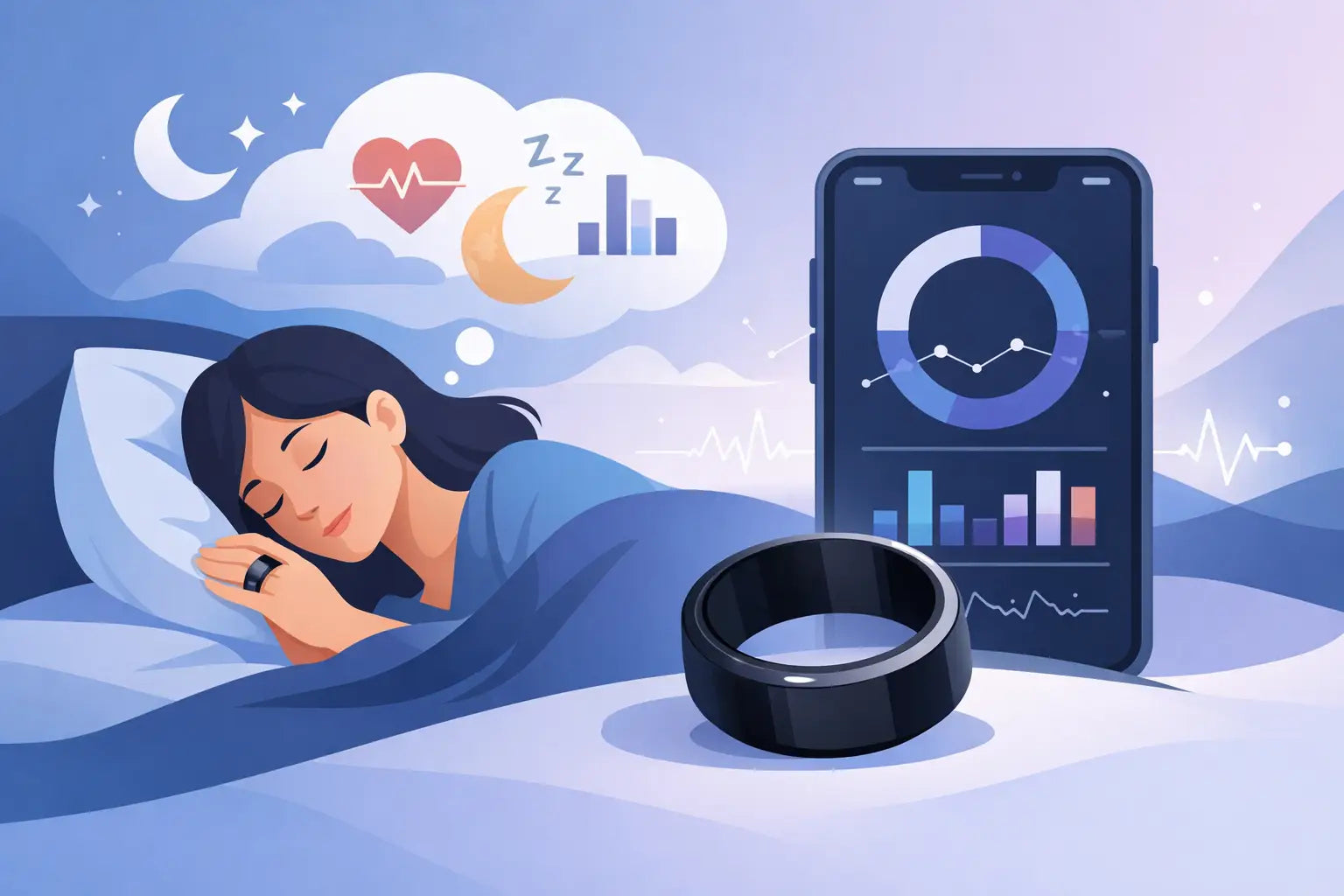
This format is particularly effective at night. Sensors on the finger sit close to the skin, allowing them to capture sleep and recovery data very comfortably. This is one of the main reasons many users prefer wearing a ring long-term over a watch. What is comfortable at night is more likely to be used consistently—and only consistent use provides truly useful trends.
A smart ring for everyday use or a smartwatch?
The honest answer is: it depends. Anyone who wants to read messages on their wrist, answer calls, or look directly at a display while jogging will often be better served by a smartwatch. A ring is not a mini-smartphone. It isn’t meant to do everything.
Its strength lies elsewhere. A smart ring is the better choice when discretion, comfort, and a clean design are more important than notifications on a display. It is aimed at people who want to use health data without constantly being surrounded by technology.
Visually, the difference is also clear. A watch is always visible and makes a statement. A ring is more subtle. This is a real plus, especially for professionals, fashion-conscious buyers, and anyone who does not want to replace their classic watches.
The trade-off is clear: less display, less direct interaction, but more restraint and often a more comfortable feel in everyday life. For many, that is exactly the reason for the switch.
What matters for a smart ring in everyday life
Not every ring that looks smart works well in daily life. Comfort is the first deciding factor. If a ring pinches, sits too loosely, or interferes with sleep, you won’t wear it consistently. The right size is therefore more important than many think when making their first purchase.
Next comes the usability of the app. Data must be quickly understandable. No one wants to open five menus in the morning just to find out if the night was good. Good wearables show developments clearly without becoming medically complicated. That is exactly what makes them valuable for daily use.
Another point is design. A ring is not only worn during exercise, but also at work, while eating, going out, and sleeping. Therefore, it should not look like a technical gadget that just happens to be on your finger. High-quality materials, different colors, and a minimalist look make the difference between “I use it sometimes” and “I wear it every day.”
The purchasing process itself also plays a bigger role than initially assumed. Many potential buyers hesitate because of sizing or because they are unsure whether a ring will suit them at all. Digital ring-sizing tools, free exchanges for the wrong ring size, and a trial period provide real peace of mind. This is especially important for a product that is meant to be worn every day.
Who benefits most from a smart ring in everyday life
A smart ring is particularly well suited to people who want to get more out of their daily well-being without changing their style. Professionals benefit because they can keep an eye on their health and recovery without sitting in a meeting with a flashy fitness watch. Sleep optimizers like the ring because it can be significantly more comfortable at night than larger wearables. And fitness-oriented users appreciate that activity and recovery data help them better assess their exertion.
The format is also interesting for beginners. Many want to use health data but feel overwhelmed by complex sports watches. A ring can be a more relaxed entry point. It collects relevant values in the background and makes usage easier.
It is less suitable for anyone who expects maximum interaction directly on the device. If you want to constantly tap on displays, monitor workouts live, or see every app notification on your wrist, a ring will not fully meet your expectations. In that case, the question is whether you are really looking for an unobtrusive tracker—or rather a multifunctional device.
What many underestimate before buying
The most exciting question is often not whether a ring can measure technically. The more important question is: will you wear it consistently? That is what determines its usefulness. A device that offers many features but becomes annoying after ten days is of little help. A ring that you almost forget about in the morning, at the office, during exercise, and at night usually provides more value in the long term.
That is why it is worth paying less attention to advertising promises before buying and more to everyday factors. How easy is it to find the right size? Is there a low-risk trial option? How quickly can you understand the data? Does the product feel like technology or like part of your style?
Brands that take these hurdles seriously make the difference. That is why Fitorb focuses not only on sensors and design but also on practical security in the purchasing process—for example with a ring-sizing tool, free exchanges, and a trial period that takes the pressure off. This is not a side issue, but a real part of everyday usability.
The real advantage: less technology, more routine
The best smart ring is not the one that makes the loudest impression, but the one that is quietly useful. It does not constantly remind you that you are wearing a wearable. Instead, it becomes part of your routine. You sleep with it, work with it, move with it, and glance at the data when it makes sense for you.
That is exactly where its strength lies in everyday life. Health is not treated as a project that takes extra time. It becomes visible in the background. This makes it easier to recognize habits and make smarter small decisions—going to bed earlier, dosing exertion better, and assessing activity more realistically.
Anyone who does not want a bulky watch for this will find a smart ring to be a very compelling alternative. Not for everyone, but surprisingly suitable for many. And sometimes the best technology is exactly the kind that does not push itself to the forefront, but simply comes along with you every day.


Leave a comment
This site is protected by hCaptcha and the hCaptcha Privacy Policy and Terms of Service apply.