
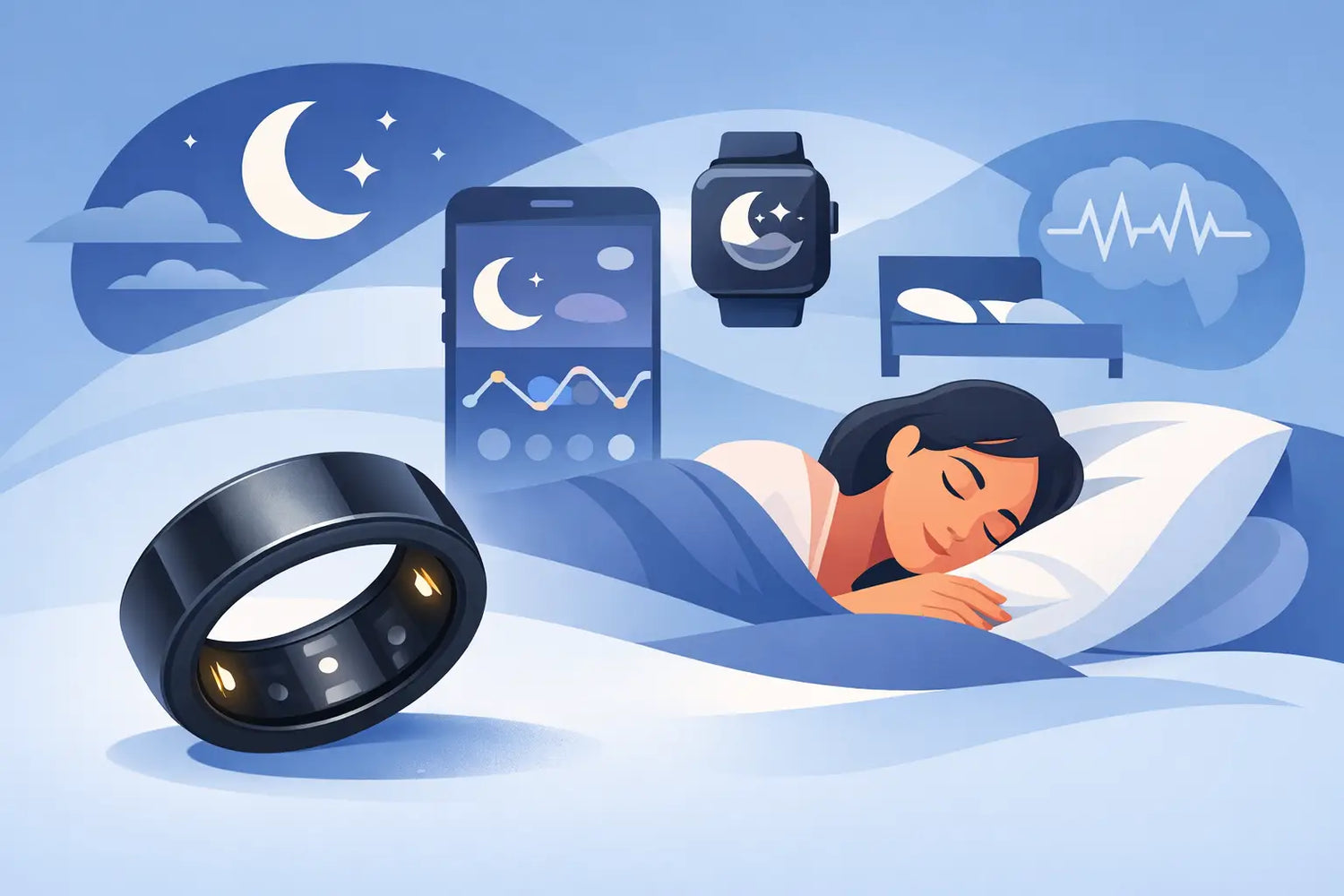
Anyone who wakes up tired in the morning, even though they had enough time to sleep, usually needs better insights rather than more motivational quotes. This is where a smart ring for better sleep becomes particularly appealing: it sits discreetly on the finger, doesn't interfere with sleep, and shows what really happens at night—instead of merely estimating whether your sleep was "okay".
Many people know the problem. The smartwatch ends up on the nightstand in the evening because it is too bulky, digs into the wrist, or simply isn't suitable for sleeping. A ring feels different. It is more discreet, lighter, and fits much more naturally into everyday life. That is exactly why, for many people, it is not just another gadget, but the first solution they will wear consistently.
Why a smart ring for better sleep fits so well into everyday life
Sleep tracking only works if you actually wear the device every night. That may sound obvious, but it is the crucial point. A wearable can have as many features as it wants—if it interferes with sleep, the data will remain incomplete and the benefits limited.
This is where a smart ring plays to its strengths. It is small, elegant, and barely noticeable in everyday life. In bed, this means no wide display, no bulky band, and no feeling of technology on the body. For many professionals, frequent travelers, and anyone who prefers a minimalist approach, this is exactly what makes the difference between short-term interest and long-term use.
There is also an aesthetic factor that is often underestimated. Many people want to track their health data without looking like they have just come from a workout around the clock. A ring looks more premium, more understated, and suits business, leisure, and dinner better than a typical fitness tracker.
What a good sleep ring actually measures at night
For a smart ring for better sleep to be truly helpful, it must be able to do more than just count how long you slept. Relevant models capture several metrics at the same time to provide a more realistic picture of the night.
These usually include heart rate, movement patterns, and often blood oxygen measurement. These signals can be used to derive sleep stages, falling asleep times, interruptions, and recovery metrics. This is particularly useful because sleep quality is not determined solely by how many hours you spent in bed.
It only becomes interesting when patterns become visible. Perhaps you sleep more restlessly after late meals. Perhaps your recovery drops on stressful workdays. Perhaps you wake up more often than you consciously realize. These are the details that turn a gut feeling into concrete information.
It is also important to manage expectations. A smart ring is not a substitute for medical diagnostics. It is not a sleep lab at home. What it can do very well is make trends visible, help you understand your habits, and support you in making better decisions about your recovery.
Better data, better decisions
The real added value begins not with the measurement, but with the changes that follow. Sleep tracking is of little use if the data merely looks interesting. It becomes valuable when you recognize which factors actually influence your sleep.
After a few weeks, many users find that their sleep is less random than they thought. Alcohol in the evening, late-night scrolling, irregular bedtimes, or intense workouts just before going to bed often leave clear traces. A ring makes these connections tangible.
This provides something many people lack in their daily lives: orientation. Instead of masking every instance of tiredness with coffee, you can better understand your daily rhythm. Instead of blindly sticking to routines, you see what works and what does not. That is exactly why a smart ring for better sleep is not just a tracker, but a practical tool for behavioral change.
Who benefits most from a smart ring?
Not everyone needs the same wearable. But there are clear situations in which a sleep ring is particularly useful.
If you have never wanted to wear a smartwatch at night, a ring is often the more comfortable alternative. If you value a stylish, understated design, it also fits better into everyday life. And if you want to understand based on data why your energy levels are sometimes high and sometimes surprisingly low, it provides exactly the kind of insight that traditional step counters cannot offer.
This is particularly appealing to people with busy schedules. Anyone who has little time for conscious recovery between work, training, family, and social commitments will benefit greatly from clear, simple signals. Not theoretical ones, but ones that apply directly to everyday life. Did I really recover? Was the night deep enough? Is today more suited to exertion or to balance?
Smart ring or smartwatch—which is better at night?
The honest answer is: it depends. A smartwatch can bundle more features at once, such as messages, navigation, or training views. If that is exactly what you are looking for and you have no problem wearing it at night, it will serve you well.
When it comes to sleep comfort, however, the ring often has the edge. It is more discreet, lighter, and less distracting. At night, it does not matter how much a device can theoretically do, but how comfortable it actually is to wear. Only then will it stay on your body week after week.
Another advantage is its discretion. A ring blends almost invisibly into your look. This is a real plus for many, because health monitoring no longer has to look like a gym. It can also be simple, premium, and suitable for everyday life.
What to look for when buying
Not every ring automatically suits every lifestyle. Good sleep data is of little use if the ring is uncomfortable or if you are unsure about the size. That is exactly why the fit is a key factor. A ring must fit tightly enough to measure accurately, but still remain comfortable to wear.
The app is just as important. Data should not be complicated, but presented in an understandable way. If you have to open ten menus before getting a clear picture of your night, you will quickly lose motivation. Good systems show you at a glance how you slept and where improvements are possible.
Customer service also plays a bigger role than many initially think. Especially when buying a ring online, topics such as size guides, exchanges, and trial periods are crucial. If you can order without risk, you can make a decision with much greater peace of mind. That is exactly what lowers the hurdle to actually trying out a new wearable.
Why design is not a side issue for sleep tracking
Technology that you wear every day must not only work, but also feel good. This is especially true for a ring. It accompanies you at work, in the gym, at dinner, and, of course, while you sleep. If design and comfort are not right, you will eventually leave it aside.
That is why a premium look is not a superficial extra, but part of the value. A ring that blends stylishly into everyday life will be worn more consistently. And consistent wear is the foundation for reliable sleep data.
This is exactly where a modern brand like Fitorb starts: health monitoring should not look bulky, overly technical, or complicated, but elegant, understandable, and immediately useful. This appeals to a target group that wants to know more about their body without having to compromise on style.
What you can realistically expect from a smart ring for better sleep
A ring will not completely change your life overnight. Anyone who constantly goes to bed too late, lives under constant stress, and consistently deprioritizes recovery will not get a miracle solution on their finger. But it can provide something very valuable: honest feedback.
And that is exactly what is often missing in everyday life. We rely on our gut feeling, even though our intuition about sleep can be surprisingly inaccurate. Some nights seem okay but are not. Others feel short but were more restorative than expected. A ring brings more clarity to this gray area.
Over time, this often leads to a new approach to sleep. Not perfectionist, but more conscious. You recognize which evenings do you good. You notice when your body needs recovery. And you no longer make decisions based solely on your calendar, but also on what really gives you energy.
So anyone looking for a discreet alternative to a smartwatch and who no longer wants to leave sleep to chance will find a smart ring to be a highly practical entry point. Not as a status symbol, but as a subtle tool with a tangible effect—especially when you are ready to actually respond to the signals.
In the end, it is not about monitoring every night. It is about finally understanding why good sleep sometimes eludes you—and what you can change without making your life more complicated.

Leave a comment
This site is protected by hCaptcha and the hCaptcha Privacy Policy and Terms of Service apply.