
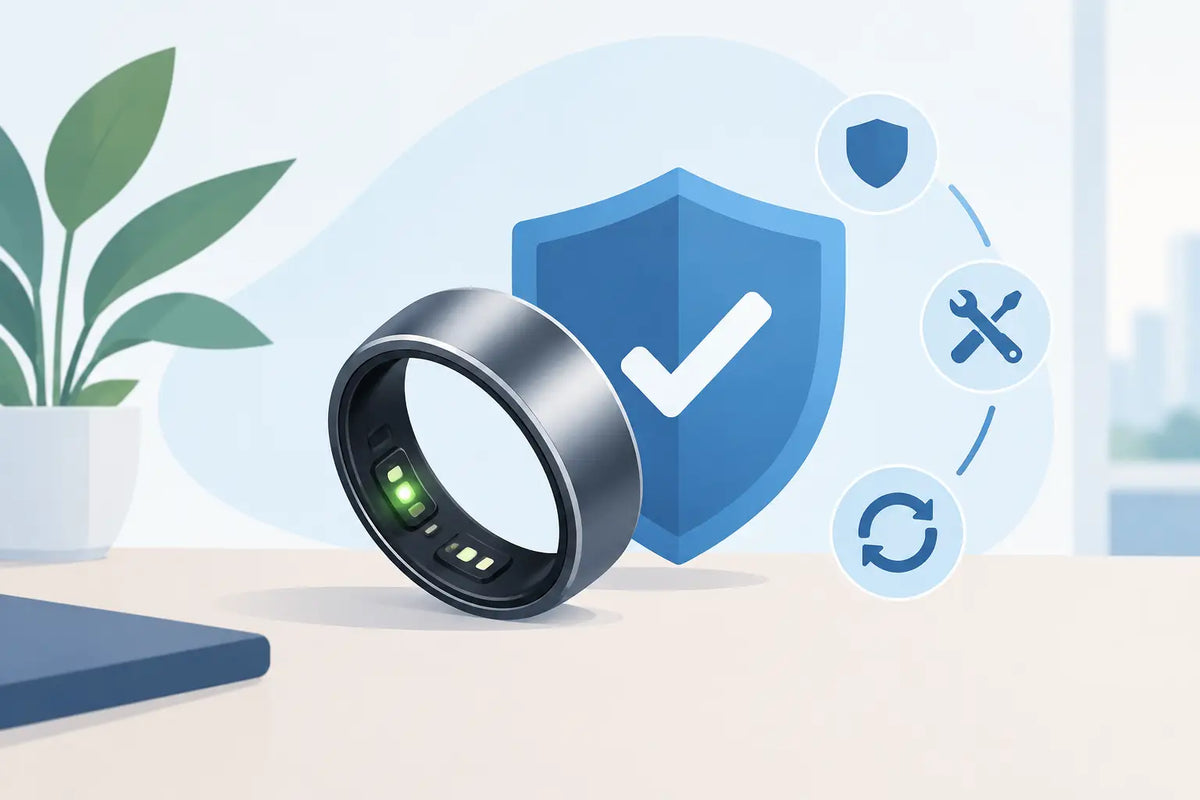
A smart ring is designed to make your everyday life easier: tracking your sleep, monitoring your activity, and discreetly supporting your health right on your finger. That is why it is all the better if you understand the smart ring warranty before making a purchase. There are differences between statutory rights, voluntary manufacturer warranties, and trial periods that can determine how truly worry-free your purchase really is.
Especially with a wearable that you wear every day, sensors, battery life, and design are not the only things that matter. Another important question is: What happens if the ring does not fit, a function unexpectedly fails, or it simply does not suit your everyday life? Those who know the terms can buy with greater confidence—and use the smart ring for exactly what it is intended for: to gain greater insight into their own well-being.
Understanding the smart ring warranty: A warranty is not the same as statutory rights
In everyday language, the two terms are often used interchangeably. Legally and practically, however, they mean different things. Statutory rights apply if a product already had a defect at the time of delivery. They are directed at the seller and generally last for two years in Germany.
A warranty, on the other hand, is a voluntary additional service. It can be offered by the manufacturer or retailer and may have its own rules, such as a specific duration, a defined scope, or specific conditions of use. That is why it is worth paying attention not only to the word "warranty" but also to the terms behind it.
For you, this means: Statutory rights protect you against defects that existed from the outset. A warranty may go beyond this, but it does not have to. For example, it may cover certain material or functional defects, while damage caused by drops, improper use, or heavy wear and tear may be excluded.
The first twelve months are particularly relevant
When purchasing from a commercial retailer, it is generally presumed during the first twelve months that any defect that arises was already present at the time of delivery. If your ring shows charging problems during this time for no apparent reason, no longer measures reliably, or cannot connect, this is relevant for assessing your claim.
After this period, determining the cause may become more complicated. This does not mean that you automatically no longer have a claim. However, it may be important to show that the cause was inherent in the product from the outset. Therefore, keep your order confirmation, billing details, and, if applicable, any communication with customer service.
What may typically be covered by a smart ring warranty
A smart ring is a compact electronic device with sensors, a battery, charging accessories, and an app connection. When discussing a warranty or statutory rights, the focus is often on defects that impair normal use. This may include a battery that can no longer be charged despite correct charging, a persistently disrupted Bluetooth connection, or sensors that no longer collect data.
Manufacturing defects can also be relevant. For example, if a component comes loose without external impact or the ring shows an unusual material defect early on, the seller should examine the case. The specific individual case always determines the outcome: a demonstrable defect is different from cosmetic changes caused by daily wear.
When it comes to health and sleep data, a realistic perspective is also important. A smart ring provides valuable trends and insights for your everyday life, but it is not a substitute for a medical diagnosis. Individual discrepancies can be caused by fit, skin contact, movement, temperature, or the specific situation. Not every measurement discrepancy is automatically a product defect.
What is usually not covered
No wearable is completely protected against all signs of everyday wear. Scratches, abrasion, or changes to the surface can occur on a ring that comes into daily contact with keys, dumbbells, bags, or cleaning products. Such normal signs of wear and tear are generally not covered by a warranty.
The same applies to damage caused by impacts, crushing, attempted self-repairs, or use outside the intended guidelines. If a ring is lost or damaged in an accident, a standard warranty will normally not apply either. Also check the product information regarding water: water resistance does not automatically mean that every type of water, depth, and duration is covered.
This is not a disadvantage of any particular ring, but is common with compact electronics. The important thing is that the rules are clearly communicated and that you know how to properly protect your wearable in everyday life.
Returns, trial periods, and warranties serve different purposes
A warranty helps if there is a technical or material defect. A trial period answers a different question: Is the ring right for you? Perhaps you like the design but find that you prefer sleeping without a ring at night. Perhaps you expect a different way of presenting data in the app. This is where a voluntary return policy or money-back guarantee is particularly valuable.
At Fitorb, you have a 30-day trial period with a money-back guarantee. This takes the pressure off the decision, because a smart ring does not reveal its true value after five minutes. Only over several days can you see which sleep patterns repeat, how your activity level develops, and whether the ring truly becomes a natural part of your everyday life.
However, a return during the trial period is not the same as a complaint. When you return a product, you may simply not like it or find that it does not meet your expectations. A complaint concerns a potential defect. Both options can give you peace of mind, but they are handled differently.
The right size: Why an exchange is so important
Ring size affects both comfort and measurement quality. If the smart ring is too loose, skin contact may fluctuate during sleep or movement. If it is too tight, it will quickly become uncomfortable in everyday life. Furthermore, fingers change their circumference throughout the day—due to warmth, exercise, salt, fluid intake, or cold.
A sizing error is not a technical defect. Nevertheless, it should not make your purchasing decision unnecessarily complicated. A digital ring-sizing tool and a free exchange if the size is wrong reduce exactly this risk. Nevertheless, take time to measure before ordering, and test which finger feels natural for long-term wear.
Many people initially choose their index or middle finger because the ring fits securely there. Others prefer the ring finger if they want a particularly discreet fit. The best choice does not depend on a general rule, but on your hand, your routine, and when you want to wear the ring.
What to do if there is a potential defect
If your smart ring suddenly stops working as usual, avoid jumping to conclusions. A connection problem, for example, may be caused by a pending app update, disabled Bluetooth, or an empty battery. First check the simple causes and follow the provided instructions for charging and pairing.
If the problem persists, briefly document it. Note when it occurs, which function is affected, and what steps you have already tried. A photo or video can be helpful, for example if the charging indicator does not respond or there is a visible material defect. This information allows customer service to assess the situation more quickly.
Then contact customer service with your order number and a clear description. The more precisely the case is described, the easier it will be to determine whether a solution via support, a replacement, or another course of action is appropriate. Do not continue to use the product if a defect could compromise safe use.
What to look for before purchasing
Clear warranty communication should be specific. It should show how long the protection lasts, who your contact person is, and which cases are included or excluded. Also check whether returns, size exchanges, and complaints are explained separately. This helps prevent disappointment because you will know the right course of action for every situation.
Also read the care instructions. A high-quality smart ring is designed for everyday life, but careful handling will extend its lifespan. Remove it during activities where strong impacts, harsh chemicals, or a high risk of crushing are likely. Charge it using the provided accessories and keep the contact surfaces clean and dry.
Ultimately, good protection is not about complicated clauses, but about trust. If you choose your smart ring carefully, determine the size accurately, and know the terms, you can focus on what really matters: the small data points that help you better understand your everyday life and maintain healthier routines for the long term.

Leave a comment
This site is protected by hCaptcha and the hCaptcha Privacy Policy and Terms of Service apply.