

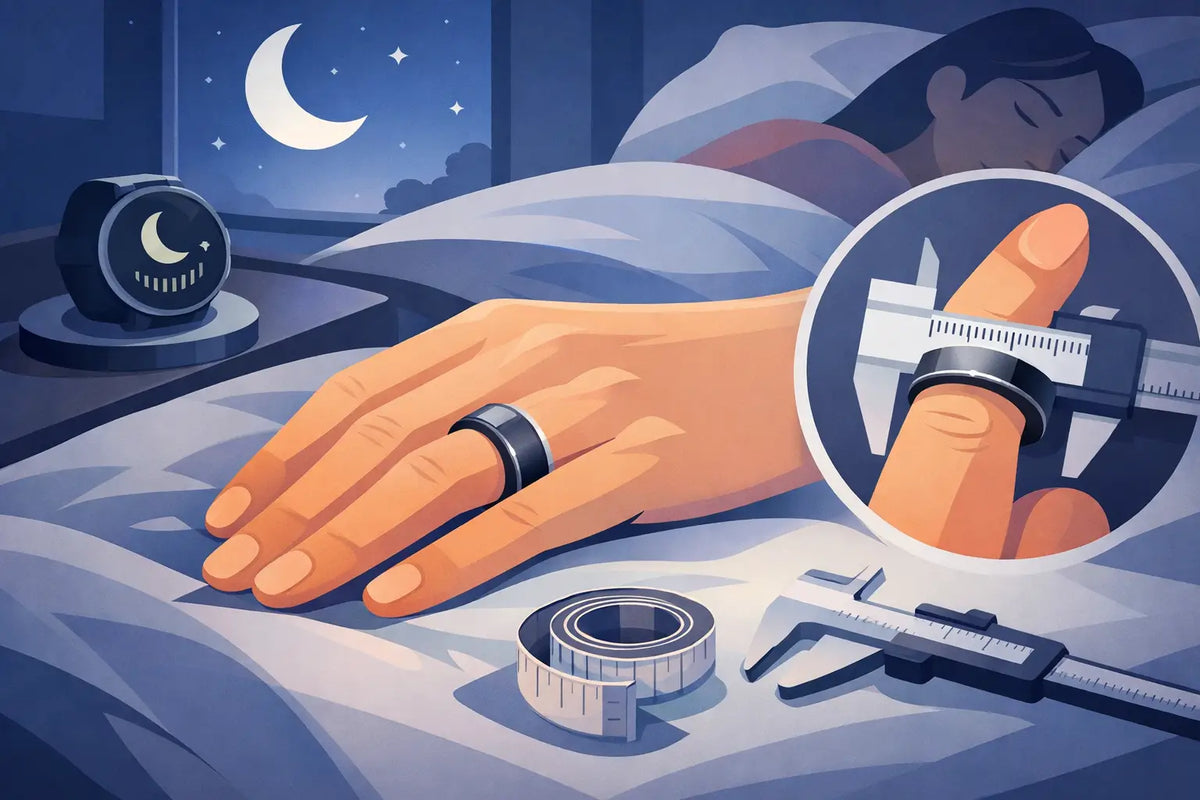
A smart ring should feel like a natural part of your everyday life. Not too loose when washing your hands, not too tight when typing, and not disruptive while you sleep. If you want to determine your smart ring size online, this is exactly what you need a solid foundation for: optimal comfort and sensors that maintain consistent contact with your skin.
Unlike a piece of jewelry, a smart ring accompanies you around the clock. However, your fingers change throughout the day—due to heat, movement, exercise, salt, fluids, or simply overnight. Choosing the right size is therefore not just a matter of appearance. It also determines whether you enjoy wearing your ring and whether your sleep, activity, and health data are recorded reliably.
Why the right smart ring size matters
A smart ring needs to fit securely and evenly. If it is too loose, it can spin or slip when you grip something. In such cases, the sensors may not always make optimal contact with your skin. If it is too tight, however, you will feel pressure points, find it difficult to remove after a workout, or take it off at night if in doubt. That is exactly when you miss out on the data you actually want to understand.
The ideal fit is comfortably snug without digging in. The ring should not slip when you shake your hand. When taking it off, it should offer slight resistance at the knuckle but come off easily and painlessly. This may sound like a minor detail, but it makes a significant difference in everyday life.
Determining your smart ring size online: The best time
Do not measure immediately after waking up or right after exercise, a sauna session, or a very salty meal. At these times, your fingers are often swollen, and the result may be larger than what is practical for your normal daily life.
The most reliable measurement is in the afternoon or evening, when your hands are at a normal temperature. If possible, repeat the test on two different days at different times. If you are torn between two sizes, this second measurement is often more helpful than a quick gut feeling.
Also pay attention to cold hands. At low temperatures, fingers often become narrower. A ring that fits perfectly then may be uncomfortably tight on warm days. Plan the fit for your real everyday life—not just for the five minutes you spend measuring.
How to use a digital ring measuring tool correctly
A digital ring measuring tool is the easiest way to check your size before purchasing. The key is not just printing or displaying the template, but using it correctly. Take a few moments to do this—it will save you uncertainty at checkout and the hassle of exchanging it later.
1. Check the print size
If you are using a print template, be sure to print it at its original size. Features such as "Fit to Page," "Scale," or "Borderless Printing" can change the dimensions. The result would then be inaccurate, even if you measure carefully.
Many templates include a control line, often with a centimeter measurement. Measure this with a ruler. If it is not exactly correct, the ring circles will also be incorrect. In this case, print the page again without scaling.
2. Decide on the desired finger
Before measuring, think about which finger you really want to wear the smart ring on. The index, middle, or ring finger of your non-dominant hand is often a good choice. The best option depends on where the ring causes the least interference during work, exercise, and sleep.
There is no single size that fits every finger. Your index finger may be significantly wider than your ring finger, and even your left and right hands often differ slightly. Therefore, always measure the exact finger you have chosen.
3. Compare existing rings effectively
Do you already wear a ring that fits well on your desired finger? Then it can serve as a guide. Place it on the printed circles and compare the inner diameter. The inner edge of the ring is what matters, not the outer rim.
However, a piece of jewelry is only a good comparison if it is similarly wide. Wider rings feel tighter than very narrow models with the same inner diameter. Therefore, use this comparison as a guideline and combine it with the digital measuring tool.
4. Use a paper strip only as a rough guide
A narrow strip of paper or a piece of string around your finger can provide a rough estimate, but it is no substitute for a proper ring template. Paper can stretch, lie crooked, or slip while you are marking. This method also only partially reflects the resistance at the knuckle.
If you use it, measure at the widest part of your finger and compare the result several times. For a final purchasing decision, a ring template or a physical ring measuring set is usually more precise.
Test the fit realistically
Once you have determined a size, think about the movements that make up your day. You type on a laptop, carry bags, cook, exercise, sleep, and wash your hands. A ring that feels comfortable while standing may press when you make a fist. Conversely, a loose ring may slip unnoticed when you climb stairs or wash your hands.
A good test ring can be rotated, but it should not slide effortlessly over the knuckle. When you make a fist, there should be no sharp pressure. After a few minutes, the finger should not throb, become numb, or visibly discolor. If you notice any of these signs, the ring is too small.
Important: A smart ring does not need to fit tightly. Sensors benefit from even contact with the skin, not from pressure. Comfort remains crucial, because only a ring you enjoy wearing during the day and at night can become a complete companion for your routines.
What to do if you are between two sizes?
Being between two sizes is completely normal. Do not decide based solely on the moment you measure, but rather on your wearing profile. If your fingers tend to swell when warm, during exercise, or at night, the larger size is often the more comfortable choice. If you wear the ring on a finger that is generally slender and the smaller version does not slip when you move, it may provide a better sensor position.
Ring width also plays a role. A slightly wider model encircles more skin and therefore feels tighter. If your smart ring has interior markings or raised sensor areas, these should also be taken into account during testing. They slightly change the wearing experience compared to a smooth piece of jewelry.
With Fitorb, free exchanges due to the wrong ring size further reduce the risk. You do not have to make your decision under unnecessary pressure. Measure carefully, consider your everyday life, and adjust easily if necessary—this makes choosing the right size predictable.
Frequently asked questions about smart ring size
Should a smart ring fit tighter than a regular ring?
Usually yes, but only slightly. A smart ring should not slip back and forth loosely because its sensors require stable contact with the skin. At the same time, it must not dig in or be disruptive while you sleep. The best fit is somewhere between the comfort of a piece of jewelry and the security of a sports ring.
Can I determine the size with a tape measure?
A flexible tape measure can provide a rough guide, but it is more prone to error than a ring template. Even a difference of one millimeter can be noticeable on a ring. Therefore, use a tape measure only as a supplement at most and check the result with a digital ring measuring tool.
Which finger is best for a smart ring?
This depends on your hand, your everyday life, and your comfort. Many people prefer the index or middle finger, while others prefer the ring finger. Choose the finger on which the ring fits securely during typical movements and that you do not consciously notice at night.
Your health data belongs in your everyday life, not in a drawer. Take a few quiet minutes to choose the right size, test it realistically, and select a fit you will still enjoy wearing tomorrow. Then your smart ring will become the discreet companion it is meant to be.


Leave a comment
This site is protected by hCaptcha and the hCaptcha Privacy Policy and Terms of Service apply.